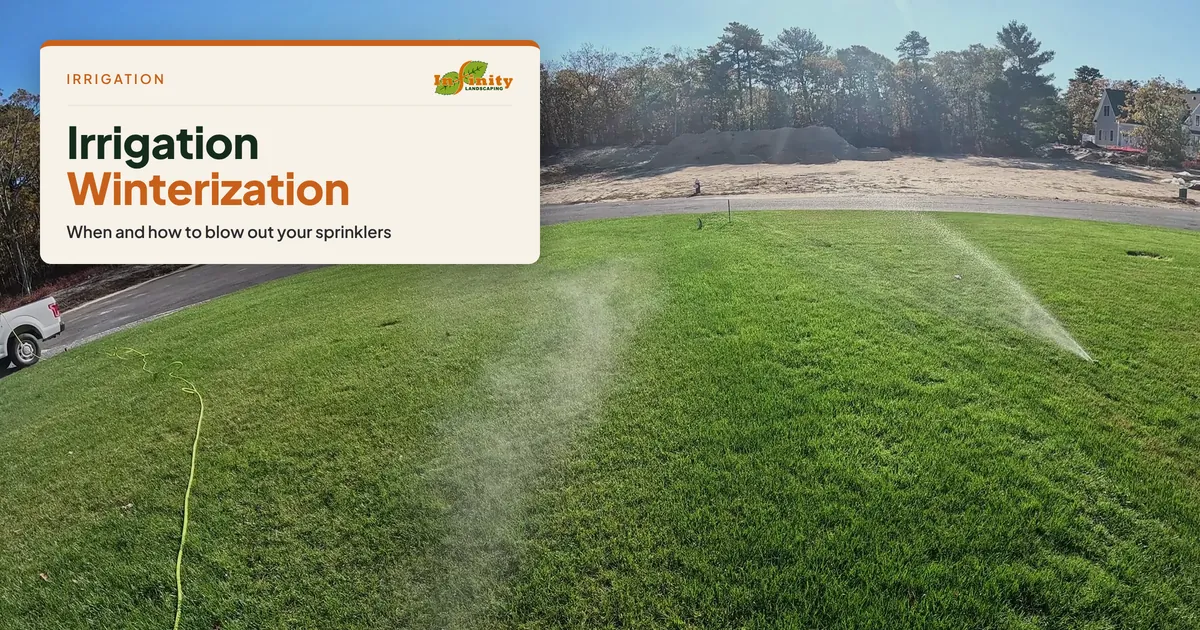
TL;DR: Irrigation winterization on Martha’s Vineyard should happen between late October and mid-November, before the first hard freeze and before a seasonal home closes. A proper blowout pushes every zone dry with compressed air, at 50 psi or less for poly pipe and 80 psi or less for PVC. Drain valves alone leave water behind, and the backflow preventer and controller each need their own winter steps.
Irrigation winterization on Martha’s Vineyard is the fall job that costs the most when it slips. Water left in a sprinkler line expands as it freezes. One cold snap can crack pipes, valves and the backflow preventer you’ll need again in May. The fix is routine if it happens before the ground freezes.
Winterization means draining the water out of a sprinkler system so nothing is left to freeze. Most crews do it by blowing each zone out with compressed air. This guide covers when to book it, how a blowout works and what happens on site. It also explains why draining alone falls short and how to protect the backflow preventer.
We do this work across the island as part of our irrigation service. That includes homes whose owners have already left for the year.
When Is the Right Time for Irrigation Winterization on Martha’s Vineyard?
Book it between late October and mid-November. NOAA averages for Edgartown show November lows near 40°F and December lows of 31°F, so the risk climbs fast after Thanksgiving. Seasonal homes should be done before the house closes, whatever the date.
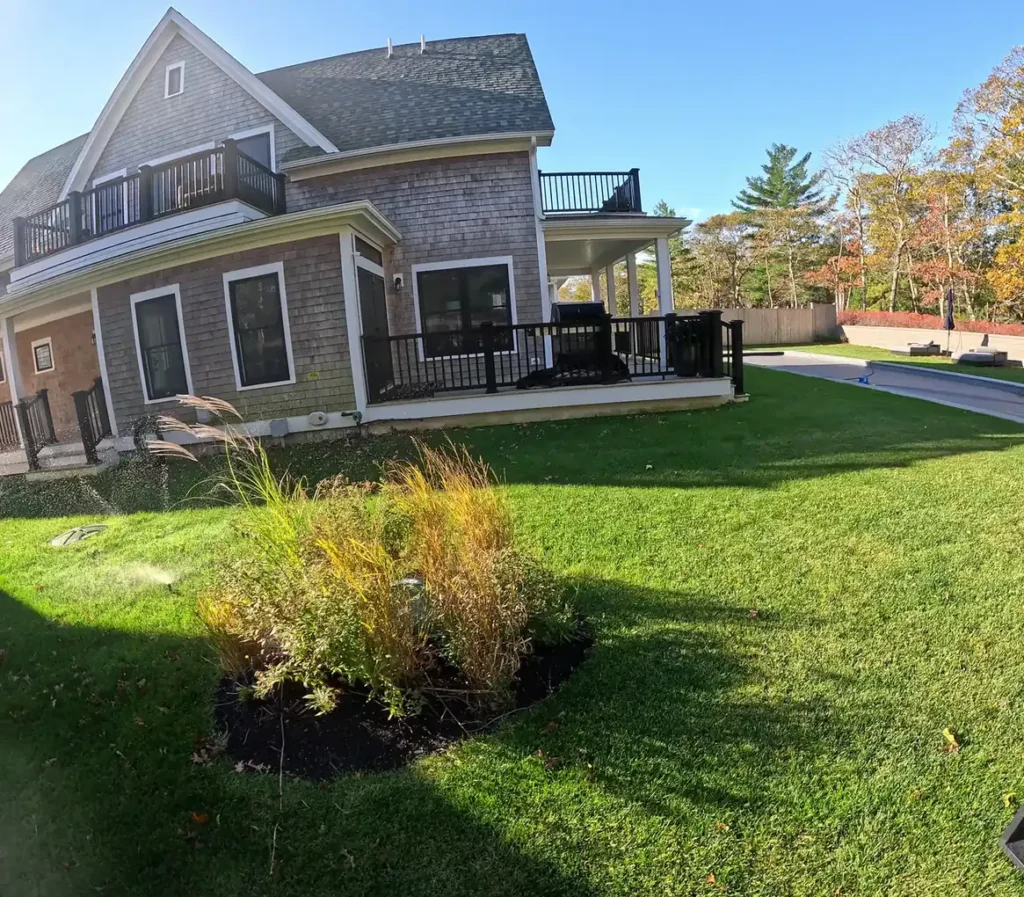
The ocean keeps island falls mild. NOAA’s 1991 to 2020 averages for Edgartown put October lows at 48°F and November lows at 40°F. Averages hide cold nights, though. A clear, still night in a low spot can drop well below the monthly figure, and exposed valve boxes freeze first.
Book the blowout for the week the property stops needing water. For year-round homes, that means no later than mid-November. The table below sorts the common situations.
| Your situation | Schedule the blowout | Why |
|---|---|---|
| Seasonal home closing in October | The week before you leave | Nobody is there to notice a leak or a frozen valve |
| Year-round home | Late October to mid-November | Lawns need little water after mid-October |
| New sod or fall seeding | Early to mid-November | New turf still needs watering into early November |
| Exposed or low-lying property | By early November | Cold air settles in low spots and open fields first |
| Missed it and it’s December | Call right away | Average December lows are below freezing |
We recommend the earlier end of each window. Dormant turf needs no water in November, so an early visit costs the lawn nothing and removes the risk of a surprise cold night.
What Happens If You Don’t Winterize Your Sprinkler System?
Water left in the lines freezes and swells, and it can crack pipes, fittings, valves, heads and the backflow preventer. Colorado State University Extension notes that water expands by one-eleventh as it freezes, so 11 cubic feet of water becomes roughly 12 cubic feet of ice.
That extra volume has nowhere to go. The damage usually stays hidden until spring start-up, when a cracked line floods a bed or a split valve won’t hold pressure. By then you’re digging and repairing in the busiest weeks of the season.
Backflow preventers are among the costlier parts at risk. Each one sits above ground in the wind, and its body and internal parts crack when water freezes inside.
How Does a Sprinkler Blowout Work?
A sprinkler blowout uses an air compressor to push water out of every zone until only mist comes from the heads. Air pressure stays at or below 50 psi for flexible polyethylene pipe and 80 psi for rigid PVC. Each zone runs in short cycles, working from the zone farthest from the compressor.
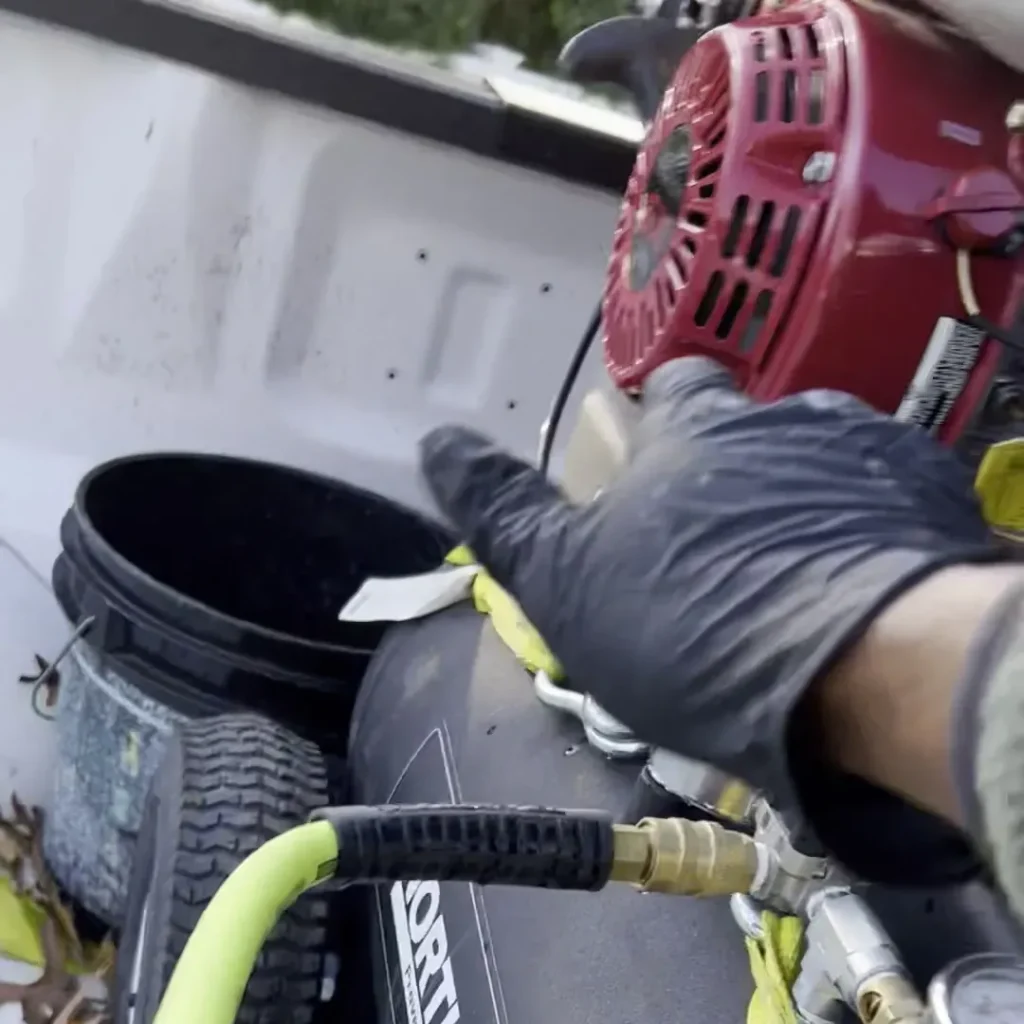
Hunter Industries’ winterization guide lays out the order most professionals follow:
- Shut off the water supply to the irrigation system.
- Connect the compressor to the blowout point with its valve closed.
- Start with the zone farthest from the compressor and open the compressor valve slowly.
- Run each zone in two or three short cycles, about 2 minutes or more, until the heads spit only mist.
- Work back toward the compressor, zone by zone.
- Disconnect, release the pressure and cycle the backflow isolation valves to let trapped water escape.
Air volume matters as much as pressure. Hunter’s rule is to divide the flow of your largest zone, in gallons per minute, by 7.5. The result is the air flow you need in cubic feet per minute. A small home compressor often can’t deliver that, so water stays in the low points.
Run time adds up on a big system. By those numbers, a ten-zone system needs roughly 40 to 60 minutes of air time alone, before setup and shutdown.
Inside a Winterization Visit: What Our Crew Does
Infinity Landscaping, a Martha’s Vineyard landscaping and hardscaping company, winterizes irrigation systems in all six island towns. We work on any system, not only ones we installed.
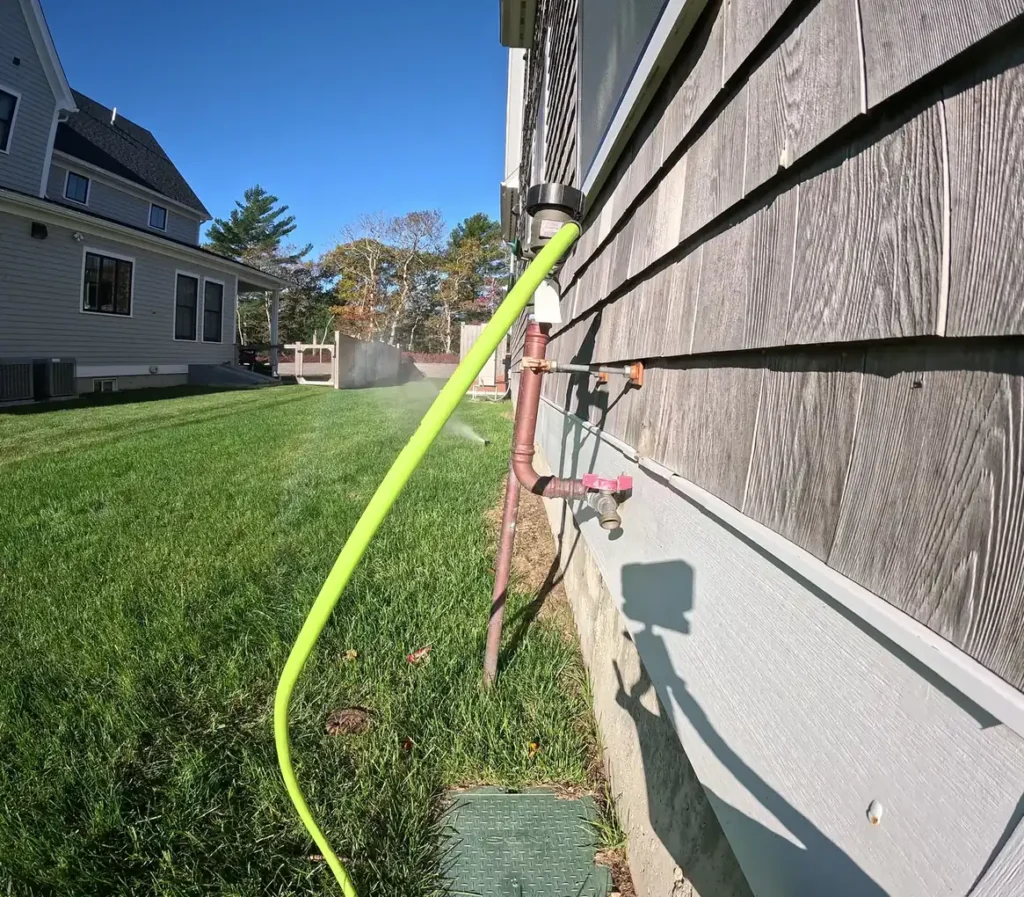
Each visit follows the same order:
- Shut off the water to the system and drain and insulate the backflow preventer.
- Connect the compressor’s air hose at the blowout point.
- Blow out every zone with compressed air until only mist is left.
- Set the controller for winter.
- Note any leaks or broken heads for the spring start-up.
The compressor rides on the truck. A handheld remote lets the technician start each zone while walking the lawn, so every head can be watched as it clears. A head that sputters, leaks or won’t pop up goes on the list for spring.
You can read more about the service on our irrigation winterization page.
How Do You Protect the Backflow Preventer for Winter?
Drain it, leave its isolation ball valves partly open, and insulate it along with the valve boxes. Colorado State says a pressure vacuum breaker’s valves stay half open for winter. A valve that’s fully open or fully shut can trap water, and that water freezes and cracks the body.
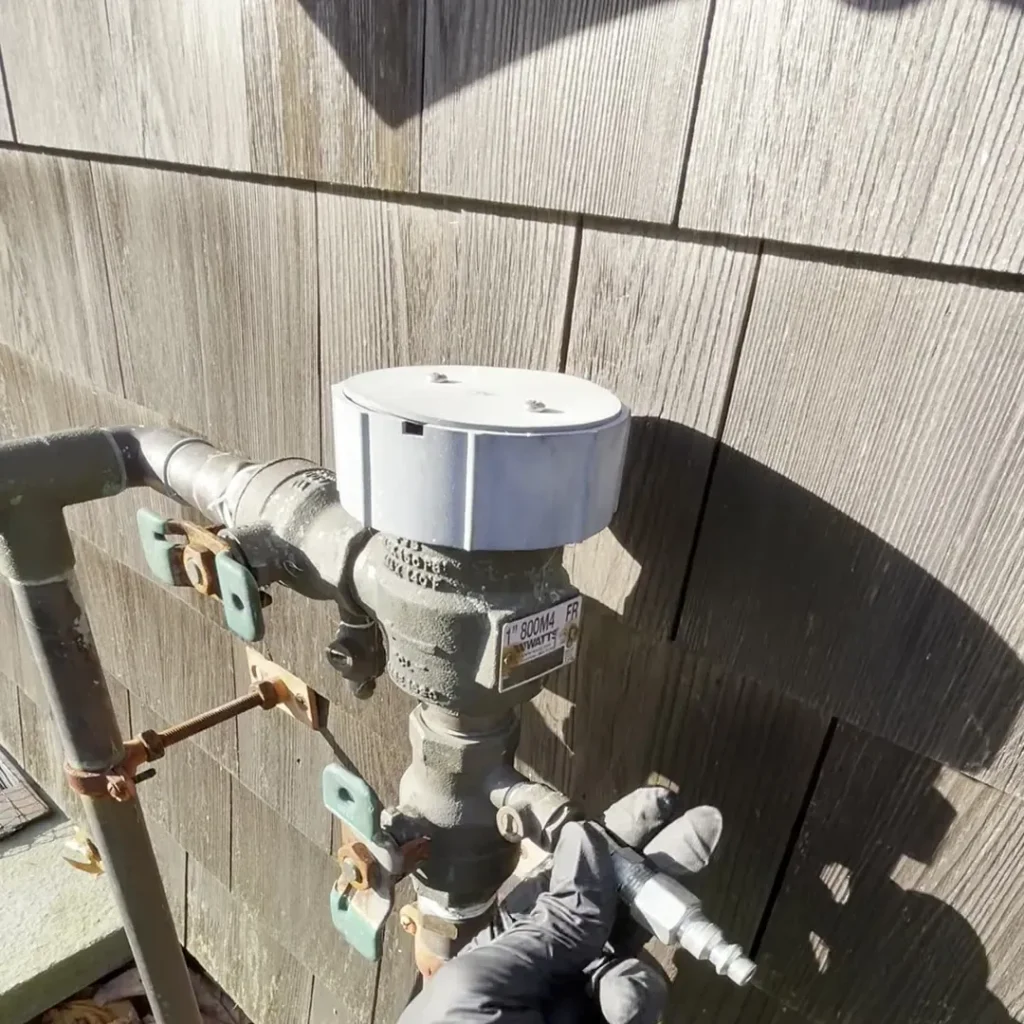
The right position depends on the device. Colorado State gives about 45 degrees for a reduced pressure device while it drains. Hunter also leaves the isolation valves at roughly 45 degrees, half open, with the test cocks open. Insulating the valve boxes and the device itself is standard practice, and Rain Bird’s homeowner guide recommends it.
Massachusetts regulates these devices too. Under the state’s backflow rules, 310 CMR 22.22, the required check depends on the device type. Your town water department may also run its own program.
| Device type | Required check under 310 CMR 22.22 |
|---|---|
| Reduced pressure principle device | Inspected twice a year |
| Double check valve assembly | Tested once a year |
| Pressure vacuum breaker | Tested at least once a year by the owner |
The fall visit is a good time to look the device over for cracks and book its spring test.
How Should You Set the Irrigation Controller for Winter?
Leave the controller powered and turn its dial to OFF. Hunter recommends keeping the power on so the clock and settings are ready in spring. The OFF position stops the system from running while the lines are empty.
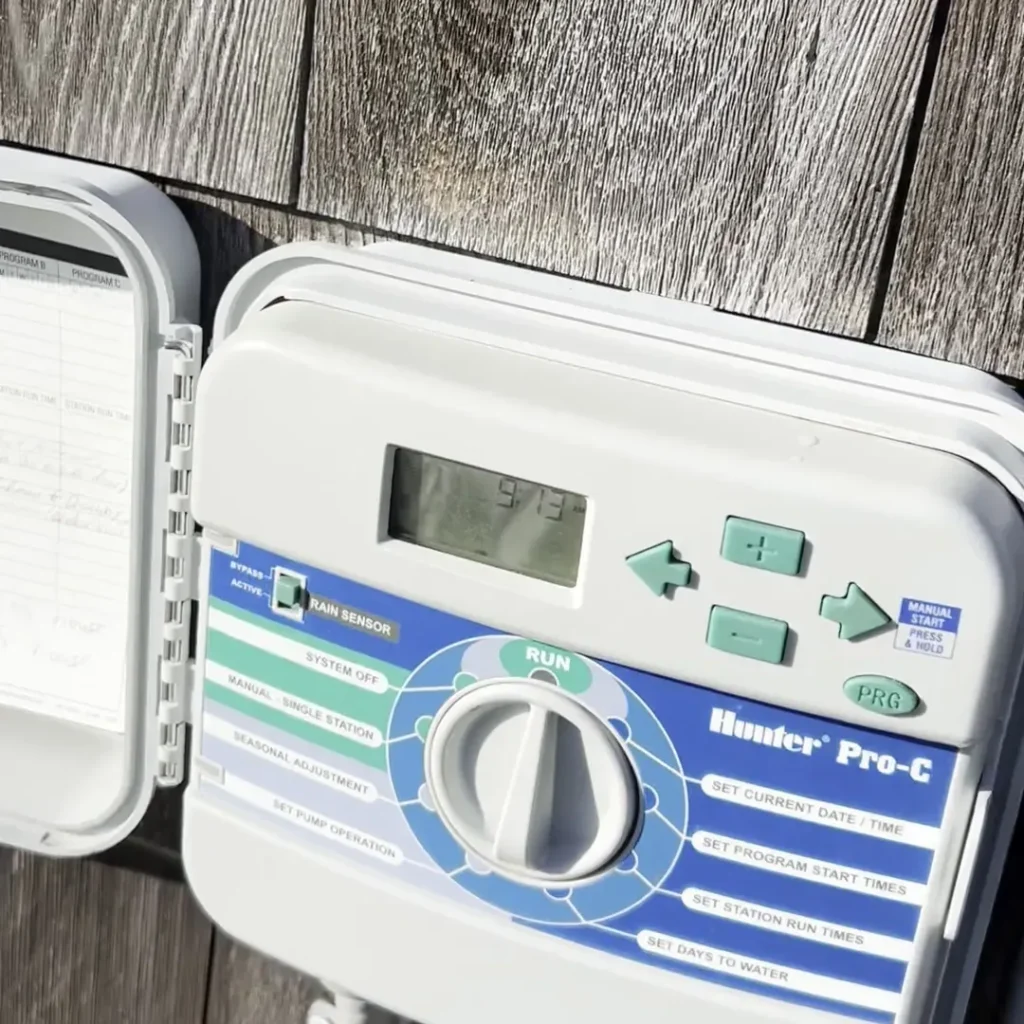
On a Hunter Pro-C like the one pictured, that means moving the dial to System Off. Smart controllers have their own off or pause setting, so check the manual for your model.
If your system still runs on a fixed timer, plan smart irrigation over the winter. It waters by the weather, not the calendar.
Why Draining and DIY Blowouts Fall Short
Colorado State’s advice is blunt. Don’t trust drain valves, because compressed air is the only sure way to clear the system. On an island lot with rolling grades, the low spots that drain valves miss are where water tends to sit.
DIY blowouts carry their own risks. Hunter warns that air moving through dry pipe creates friction and heat that can damage the system. Each zone should stop once it runs dry.
Rain Bird’s guide adds two safety rules. Wear eye protection, and never stand over sprinkler heads or valves while air is flowing.
Hunter recommends a qualified, licensed contractor for the job. Too much pressure can blow apart fittings and heads, and too little leaves water behind. A small home compressor may not meet the air-volume rule above.
Island Conditions: Seasonal Homes, Salt Air and Spring Start-Up
Island water use swings hard with the seasons. Edgartown’s water supervisor told the Vineyard Gazette that the department pumps an average of 1,918,375 gallons a day in summer and about 523,000 in the off-season. When the houses empty, a slow leak can run for weeks before anyone sees it.
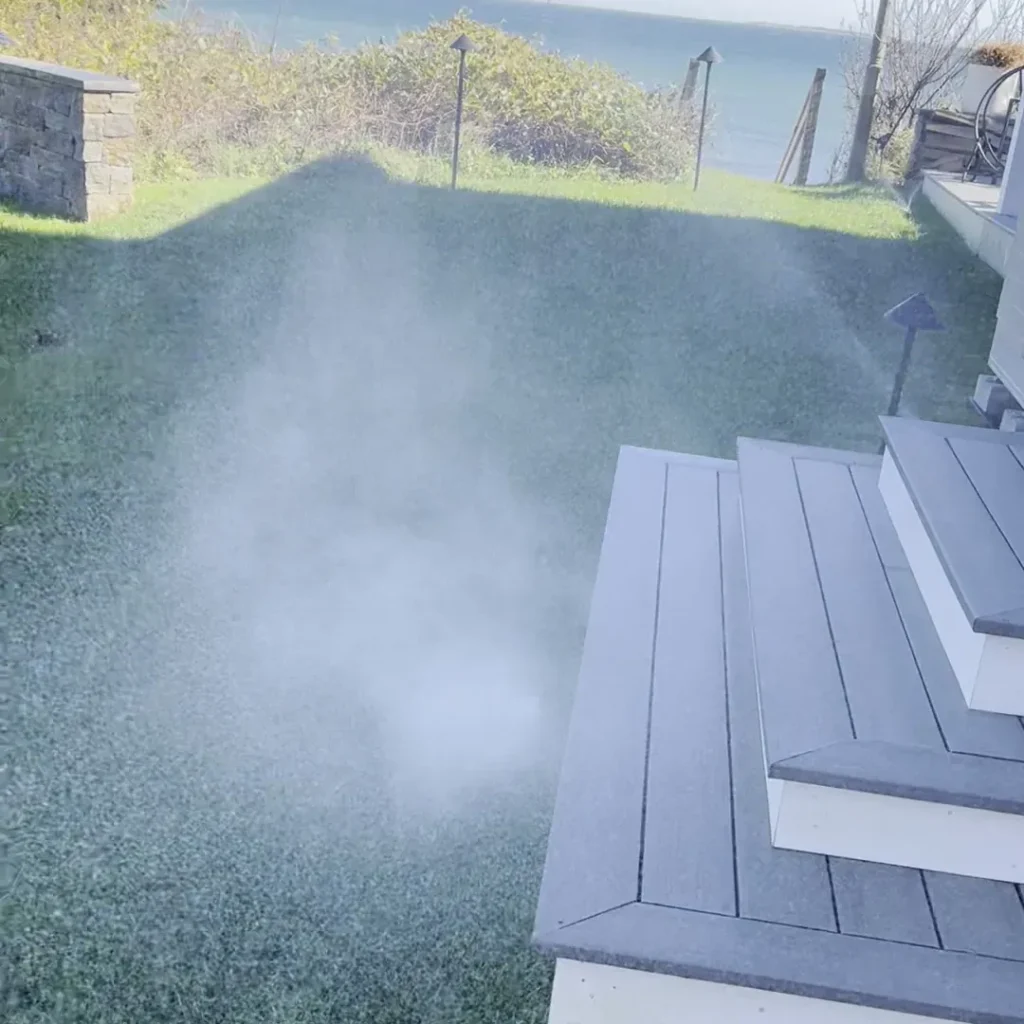
You don’t need to be on the island for a winterization. Tell us how to reach the shutoff, controller and backflow preventer, and we handle the rest, including a spring start-up booking.
Salt air is hard on exposed metal. Give controllers and valve box lids near the water a quick look each fall. A cracked lid or rusted fitting is easier to fix in November than in the spring rush.
Winterization pairs naturally with the rest of the fall checklist. Our fall cleanup covers the beds, and the lawn side of the season is in our fall lawn care guide.
Book Your Irrigation Winterization Now
Three things protect a sprinkler system through a Vineyard winter. They are an air blowout at the right pressure, a drained and insulated backflow preventer, and a visit booked before mid-November or before the house closes. Skipping any of them tends to show up as a repair at spring start-up.
Our crews winterize irrigation systems island-wide and handle irrigation repair and maintenance when spring comes. Request a free quote or call (508) 333-1071 to get your system on the fall schedule. You can also see how the irrigation winterization service works. Spring start-up can be booked at the same time.
Frequently Asked Questions
How much does irrigation winterization cost on Martha’s Vineyard?
The price depends on the number of zones, the type of system and how easy the controller, backflow preventer and zones are to reach. A larger system with more zones simply needs more air time. Whether the property is occupied or closed for the season matters too. Infinity Landscaping gives each homeowner a firm quote once we know the system, so request a free quote instead of relying on a national average.
How long does a sprinkler blowout take?
By Hunter’s numbers, each zone runs about 2 minutes in two or three cycles. A ten-zone system therefore needs roughly 40 to 60 minutes of air time. Setup, the backflow preventer, the controller and a check for broken heads add to that time.
Do you winterize irrigation systems you didn’t install?
Yes. Infinity Landscaping winterizes any irrigation system on the island, not only ones we installed. We drain the backflow preventer, blow out every zone and set the controller for winter. The steps are the same whoever built the system.
Can you winterize my system if I’m off-island?
We can, as long as we know how to reach the main irrigation shutoff, the controller and the backflow preventer. These are usually outside the house or in a utility area. Tell us how to access the property and we take care of the rest.
Is it too late to winterize in December?
It’s late, but still worth doing. Average December lows in Edgartown sit just below freezing, so every week of delay adds risk. If the lines may already have frozen, don’t force air through them; have a technician check the system first.
Can I book my spring start-up at the same time?
Yes. Spring start-up can be booked with winterization, so your system is on the calendar before the spring rush, and you can ask for both when you request a quote.