After a busy Martha’s Vineyard summer, even a well-maintained lawn can begin to show the season’s effects. Heat, dry periods, frequent foot traffic, irrigation inconsistencies and general wear can leave turf thinner, compacted or patchy by late August.
That makes late summer and early fall one of the most valuable periods for professional lawn care on Martha’s Vineyard.
For established cool-season lawns in Massachusetts, UMass Extension recommends late summer into early fall for lawn renovation and overseeding, with approximately August 15 through September 15 representing an especially favorable window for many renovation projects.
On Martha’s Vineyard, however, successful fall lawn care is not simply about following a calendar. Soil conditions, irrigation, shade, coastal exposure, lawn use and existing turf health should determine what each property actually needs.
The goal is not to perform every possible lawn service each fall.
The goal is to identify what limited the lawn during summer and use the fall growing period to correct it.
Why Fall Is Such an Important Lawn-Care Season
Cool-season turfgrasses recover most effectively when soil remains warm enough to support active root growth while air temperatures begin to moderate.
That combination makes late summer and early fall particularly useful for:
- repairing thin turf
- improving compacted soil
- introducing new grass through overseeding
- correcting minor surface problems
- improving the root zone
- preparing turf for winter
UMass recommends early fall establishment over summer seeding because cooler temperatures, reduced weed pressure and more favorable moisture conditions generally improve the chances of successful turf establishment.
Large-scale seeding projects become progressively less reliable as the season advances, which is why homeowners should not wait until late fall to begin evaluating summer lawn damage.
For Vineyard properties, the best fall lawn work often begins before the lawn looks like it needs winter preparation.
Start by Understanding What Happened During Summer
A thin lawn does not automatically mean it needs more fertilizer.
A brown area does not automatically mean it needs more water.
And a patchy lawn does not necessarily need to be completely replaced.
Before choosing a treatment, identify the underlying problem.
Typical late-summer lawn issues can include:
- thinning caused by heat or drought stress
- compacted high-traffic areas
- poor seed establishment from previous repairs
- excessive or insufficient irrigation
- weak soil structure
- low organic matter
- nutrient or pH imbalances
- excessive shade
- drainage problems
- weed competition
- insect or disease damage
Correcting the cause matters because overseeding or fertilizing without solving the original problem may provide only temporary improvement.
For example, if thin turf is primarily caused by poor sprinkler coverage, adding more seed does not solve the irrigation problem. Likewise, compacted soil should be addressed before expecting new grass to develop a deep root system.
A property-specific evaluation is therefore more valuable than automatically applying the same fall treatment to every lawn.
Martha’s Vineyard Soils Are Not All the Same
It is common to describe Martha’s Vineyard simply as having “sandy soil,” but that is an oversimplification.
According to the Martha’s Vineyard Commission, much of the Island’s main aquifer lies within glacial outwash deposits consisting largely of sand and gravel. Western and hillier portions of Martha’s Vineyard can also contain soils developed over glacial till and other heavier materials.
That difference matters.
A fast-draining lawn on one property may require a different soil-management approach from a lawn with heavier or more compacted conditions elsewhere on the Island.
This is why Infinity Landscaping takes a soil-first, property-specific approach rather than treating every Vineyard lawn the same way.
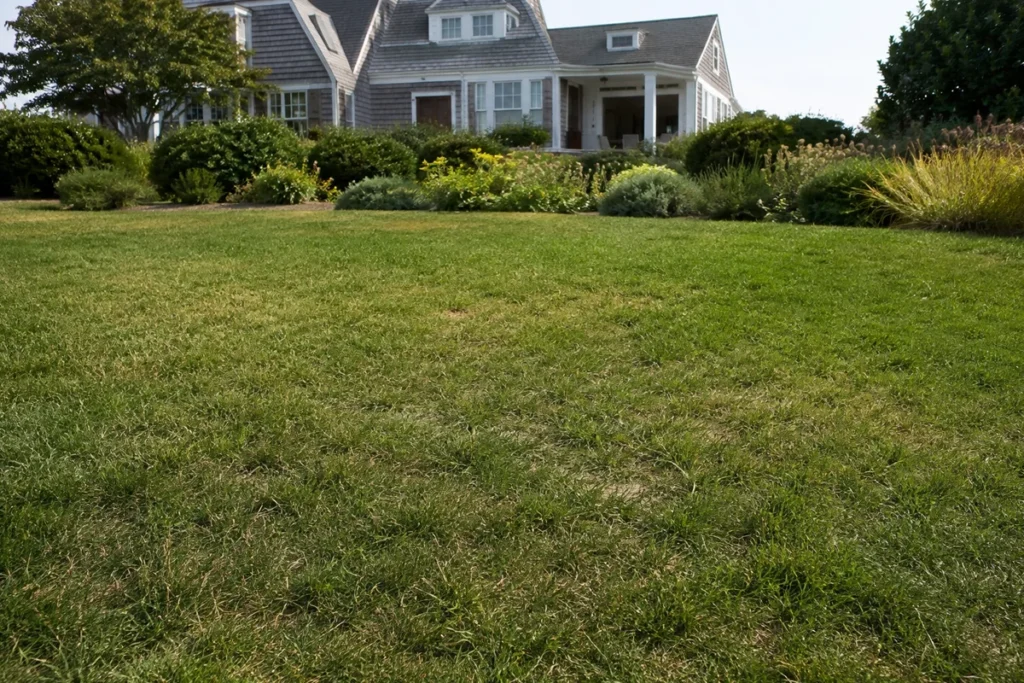
1. Core Aeration: Use It Where the Lawn Actually Needs It
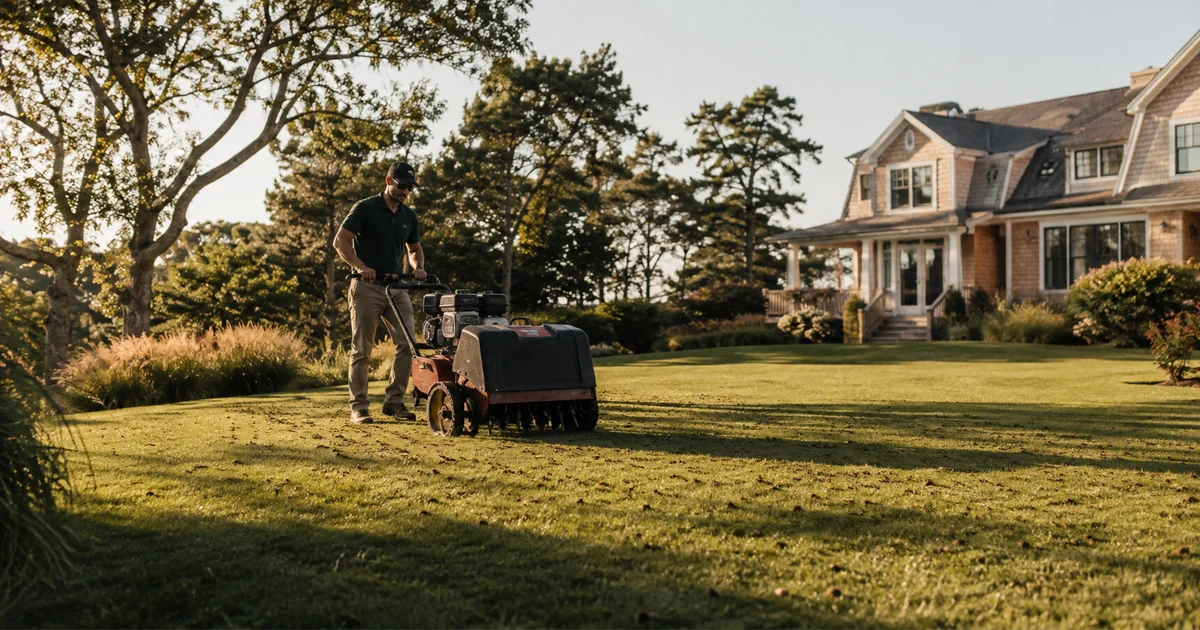
Core aeration uses hollow tines to remove small plugs of soil from an established lawn.
Its primary purpose is to reduce soil compaction and improve the movement of air, moisture and nutrients through the turf root zone.
Compacted soil contains less pore space. That can restrict oxygen availability, water infiltration and root development.
For lawns affected by summer foot traffic, equipment use or naturally compacted conditions, fall can be an excellent time to relieve that pressure.
Signs Your Lawn May Benefit From Aeration
Consider aeration when:
- frequently used areas have become noticeably hard
- turf is thin along walkways or gathering areas
- water tends to run across the surface instead of soaking in
- grass roots appear shallow
- the lawn has experienced significant foot or equipment traffic
- overseeding is planned and improved seed-to-soil contact is needed
Not every Vineyard lawn necessarily needs aggressive aeration every year.
A quiet, low-traffic lawn with healthy soil structure may require less frequent cultivation than a property that receives heavy summer use.
That is why aeration should be based on lawn conditions rather than treated as an automatic annual procedure.
Why Aeration and Overseeding Work Well Together
Aeration and overseeding are often performed together because the two processes solve different but complementary problems.
Aeration helps relieve compaction and creates openings through the turf canopy.
Overseeding introduces new desirable grass into thin areas.
The openings created during cultivation can also improve opportunities for seed to contact soil rather than remaining suspended in existing grass or thatch.
Good seed-to-soil contact is one of the basic requirements for successful germination.
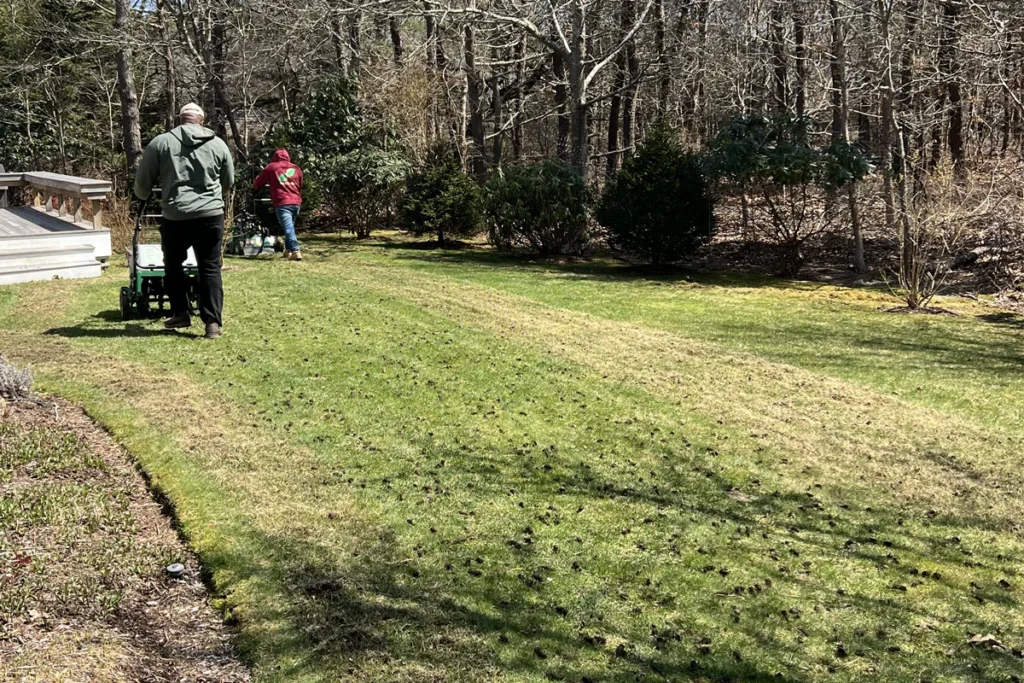
2. Overseeding: Rebuild Density Instead of Starting Over
If a lawn is fundamentally healthy but has become thin or patchy, overseeding can introduce new desirable turfgrass without removing everything already growing.
This makes it particularly useful for lawns that experienced:
- summer drought stress
- heavy foot traffic
- isolated thinning
- minor winter damage
- declining turf density
- uneven establishment from previous repairs
A denser lawn provides more complete turf coverage and reduces the amount of open soil where unwanted plants can establish.
Infinity Landscaping combines overseeding with professional lawn aeration when soil compaction or poor seed-to-soil contact is part of the problem.
Timing Matters More Than Simply Using More Seed
One of the most common overseeding mistakes is assuming that applying more seed automatically produces a better lawn.
It does not.
Successful germination depends on:
- appropriate temperatures
- reliable moisture
- good seed-to-soil contact
- proper seed selection
- suitable soil conditions
- enough growing time before winter
Using excessive seed can also create unnecessary competition between immature turf plants.
The seed mix should instead be selected according to the property.
Important considerations include:
- full sun versus shade
- irrigation availability
- summer traffic
- desired lawn appearance
- drought tolerance
- existing turf species
- coastal exposure
- soil characteristics
For many Martha’s Vineyard lawns, late August through September is the most valuable period to evaluate and perform overseeding.
What About Overseeding in October?
October does not automatically make seeding impossible.
Conditions vary from year to year, and smaller repair projects can sometimes remain viable when soil temperatures and weather are favorable.
However, the probability of successful establishment decreases as the season progresses.
UMass Extension’s late-season turf establishment guidance emphasizes that later establishment provides young turf with less time to develop before winter.
The practical strategy is simple:
Do not intentionally delay a lawn renovation project when suitable conditions are already available in late summer or September.
3. Top Dressing: Improve the Root Zone, Not Just the Surface
Lawn top dressing involves applying a thin layer of carefully selected compost, soil or another compatible material over established turf.
When used correctly, top dressing can help:
- introduce organic matter
- improve minor surface irregularities
- support better soil structure
- fill aeration holes
- improve conditions around the turf root zone
Top dressing can be particularly useful when coordinated with aeration because material can work into the openings created during cultivation.
On some fast-draining Vineyard properties, increasing appropriate organic matter can also improve the soil’s ability to retain moisture and nutrients.
However, more top dressing is not automatically better.
The objective is not to bury an existing lawn under a thick layer of material.
Excessive application can smother turf, while an incompatible material can create undesirable layering within the soil profile.
That is why professional top dressing services should begin with an understanding of the existing soil rather than simply applying the same mix to every property.
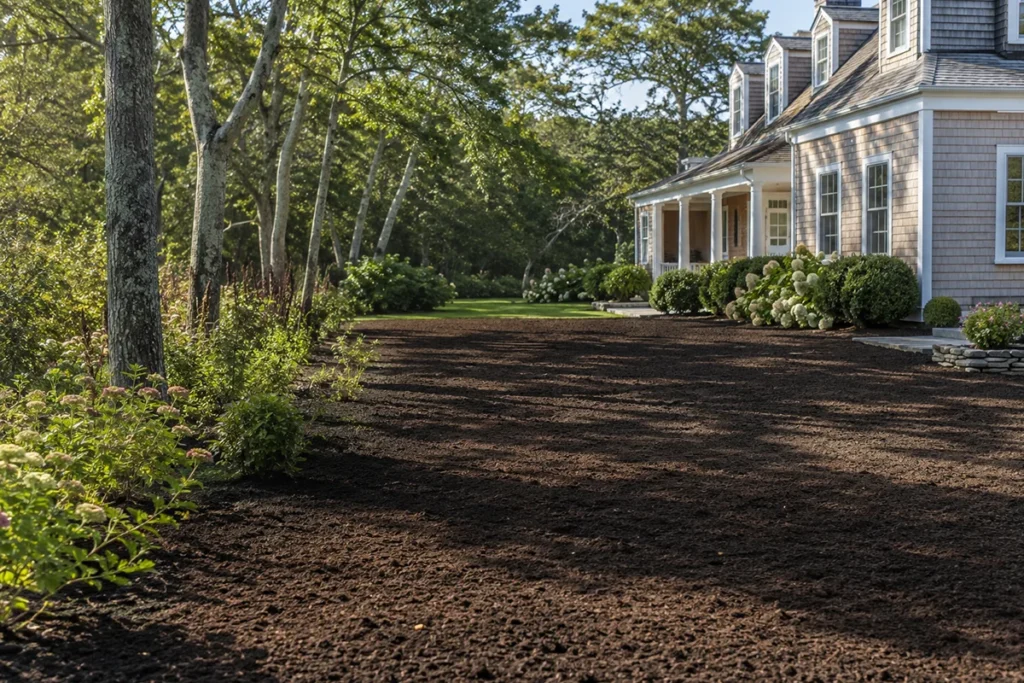
4. Should You Fertilize the Lawn in Fall?
Fall can be an important fertilization period for cool-season turf, but fertilizer should never be treated as a universal cure for every lawn problem.
The best lawn fertilization program should respond to actual turf and soil conditions.
A lawn that is thin because of shade, compaction or poor irrigation coverage will not necessarily improve simply because additional nutrients are applied.
A better process is:
test → diagnose → amend only where necessary.
This is especially important on Martha’s Vineyard because excess nutrients can eventually move through groundwater toward ponds, bays and coastal ecosystems.
The Vineyard Conservation Society encourages responsible fertilizer practices across the Island, while Massachusetts fertilizer guidance places restrictions on phosphorus use on established lawns except in specific circumstances.
When fertilizer is appropriate, the objective should be to provide the turf with what it actually needs — not simply to create rapid temporary color.
Infinity Landscaping’s lawn fertilization services are therefore best coordinated with the condition of the lawn, soil information and the rest of the seasonal maintenance program.
5. Do Not Forget Irrigation After Overseeding
Overseeding does not end when the seed is applied.
Successful establishment depends heavily on what happens afterward.
Young seedlings have very small root systems and require reliable moisture while they germinate and become established.
The exact watering schedule depends on factors such as:
- seed type
- temperature
- rainfall
- wind
- sun exposure
- soil drainage
- irrigation coverage
During early germination, the objective is generally to prevent the upper seed zone from repeatedly drying out without leaving the lawn continuously saturated.
Once new turf becomes established and roots begin developing, watering can gradually transition toward deeper, less frequent irrigation appropriate for mature grass.
This is why checking the property’s irrigation system should be part of a significant lawn renovation project.
A poorly aligned sprinkler head, blocked spray pattern, leaking component or area with inadequate coverage can turn an otherwise well-executed overseeding project into an uneven lawn.
For properties relying on automatic irrigation, fall lawn renovation and irrigation management should be planned together rather than treated as completely separate services.
6. Continue Mowing — But Avoid Scalping the Lawn
Fall is not the time to stop mowing simply because summer has ended.
Grass should continue to be cut while it remains actively growing.
A useful principle is the one-third rule: avoid removing more than approximately one-third of the grass blade in a single mowing.
This reduces unnecessary stress and helps maintain adequate leaf surface for photosynthesis.
Infinity Landscaping’s complete Martha’s Vineyard lawn care programs coordinate mowing with aeration, overseeding, fertilization, top dressing and irrigation rather than treating each service in isolation.
Newly overseeded lawns may require temporary mowing adjustments while seedlings establish.
The objective is to protect young turf while preventing existing grass from becoming so tall that it shades new seedlings.
7. Keep Leaves From Smothering Newly Established Turf
September lawn renovation is only the first half of the fall lawn-care season.
As October and November progress, leaves can accumulate quickly on Vineyard properties.
A small amount of scattered leaf material is manageable.
A thick, wet mat of leaves can block sunlight and reduce air movement around turf — exactly what young grass does not need while it is establishing.
Newly renovated areas should therefore be kept reasonably clear during the first weeks after germination.
For properties with many mature trees, lawn renovation and seasonal cleanup should be coordinated rather than managed as unrelated projects.
A Practical Martha’s Vineyard Fall Lawn Timeline
Mid-August to Early September
This is the time to evaluate what summer did to the lawn.
Priorities can include:
- inspecting turf density
- identifying compacted areas
- evaluating irrigation coverage
- checking drainage
- soil testing
- identifying weeds or damaged turf
- planning renovation work
- beginning overseeding when conditions are favorable
UMass identifies approximately August 15 through September 15 as an especially valuable renovation period for Massachusetts cool-season lawns.
For Vineyard homeowners, this means planning should begin before September is already half over.
September
For many properties, September is the primary lawn-repair month.
Potential work includes:
- core aeration and overseeding
- targeted top dressing
- soil amendments based on actual conditions
- appropriate fall lawn fertilization
- irrigation adjustments
- continued mowing
For many Martha’s Vineyard lawns, this is the most valuable recovery period of the year.
Early October
Depending on weather and turf conditions:
- continue appropriate cultivation
- monitor newly germinated turf
- make smaller repairs where appropriate
- continue mowing
- adjust irrigation as temperatures change
- begin active leaf management
Significant new seeding becomes increasingly time-sensitive as temperatures decline.
Late October Into November
The focus gradually shifts toward:
- leaf management
- final mowing as growth slows
- winter preparation
- irrigation winterization and seasonal service
- evaluating unresolved lawn issues
- planning larger improvements for the following season

Do You Need Aeration, Overseeding and Top Dressing Every Fall?
Not necessarily.
These services work extremely well together when a lawn has the right conditions, but professional lawn care should not mean automatically applying the same package every September.
Aeration may be the priority when:
Soil compaction is limiting root growth, air exchange or water infiltration.
Overseeding may be the priority when:
The existing lawn is healthy enough to preserve but turf density has declined.
Top dressing may be the priority when:
The root zone would benefit from appropriate organic matter, minor surface correction or improved soil conditions.
A larger renovation may be necessary when:
Large areas contain undesirable turf, extensive bare soil, severe weed pressure, poor grading or unresolved drainage issues.
In some cases, the correct recommendation is to do less, not more.
That decision should come from evaluating the property rather than following a predetermined treatment calendar.
Fall Lawn Care Mistakes to Avoid
Waiting Too Long to Seed
Fall may technically last until December, but the useful lawn-establishment window does not.
Young grass needs enough growing time to develop before winter.
Waiting until temperatures have already dropped significantly can reduce establishment success.
Aerating a Lawn That Does Not Need It
Aeration is an important soil-management tool, but it should solve an actual problem.
A low-traffic lawn with healthy soil may not require the same treatment frequency as a heavily used property.
Applying Seed Without Solving Irrigation Problems
If poor watering caused the original turf loss, new grass is likely to encounter the same problem.
Check irrigation coverage and system performance before investing in significant lawn renovation.
Applying Fertilizer Without Understanding the Soil
More nutrients do not automatically create healthier turf.
Unnecessary fertilization can waste money and contribute to nutrient movement into the surrounding environment.
A targeted lawn fertilization program should address actual lawn requirements.
Using the Wrong Top-Dressing Material
Top dressing must be compatible with the existing soil profile.
Applying too much material — or the wrong material — can create new problems instead of improving the lawn.
Treating Every Martha’s Vineyard Property the Same
Martha’s Vineyard contains a range of soils, exposures and microclimates.
Coastal properties can experience different wind and salt conditions than more sheltered inland sites.
Sunny lawns behave differently from shaded lawns.
Heavily occupied summer properties experience different traffic pressure from quieter residences.
The best lawn program responds to the property rather than the ZIP code alone.
The Best Fall Lawn Program Starts With the Property
There is no single recipe for a healthy Martha’s Vineyard lawn.
A successful program considers the entire system:
soil + turf + irrigation + sunlight + drainage + traffic + maintenance.
Aeration, overseeding and top dressing are valuable because they address different parts of that system.
Used at the right time and for the right reason, they can help a lawn recover from summer stress, increase turf density and create stronger conditions heading into winter.
Used without first identifying the problem, they can become unnecessary treatments.
At Infinity Landscaping, our lawn care programs are built around the individual property and can coordinate mowing, soil improvement, aeration and overseeding, top dressing, fertilization and irrigation as part of one seasonal approach.
Planning Fall Lawn Care on Martha’s Vineyard?
If your lawn looks thin, compacted or stressed after summer, late August and September are the right time to evaluate it — not after the growing season is already ending.
Infinity Landscaping provides professional lawn care across Martha’s Vineyard, including aeration, overseeding, top dressing, fertilization, mowing and complete seasonal turf programs for properties in Edgartown, Oak Bluffs, Vineyard Haven, West Tisbury, Chilmark and Aquinnah.
Request a free lawn evaluation from Infinity Landscaping →
Call: (508) 333-1071
Frequently Asked Questions
When is the best time for fall lawn care on Martha’s Vineyard?
For significant lawn repair and overseeding, late summer into September is generally the most reliable period.
UMass Extension identifies approximately August 15 through September 15 as an especially favorable renovation window for much of Massachusetts, although exact timing depends on weather, turf species and individual property conditions.
Is fall better than spring for overseeding?
For many established cool-season lawns, early fall provides excellent conditions because soil remains warm while air temperatures become more moderate.
It also allows new turf time to develop before the following summer.
Spring overseeding can still be appropriate when repairs cannot wait until fall.
Should aeration always be combined with overseeding?
No.
However, core aeration and overseeding complement each other particularly well when a lawn has both compaction and declining turf density.
Aeration improves the soil environment, while overseeding introduces new grass into thin areas.
Does every Martha’s Vineyard lawn need aeration every year?
No.
The need for aeration should depend on soil compaction, traffic, turf condition and management goals.
Heavily used lawns may benefit from more frequent cultivation than low-traffic properties with healthy soil structure.
Is top dressing good for sandy Vineyard lawns?
It can be.
Appropriate compost or compatible soil material can add organic matter and improve certain soil characteristics, but the existing root zone should be evaluated first.
Professional lawn top dressing should use material selected for the property rather than a one-size-fits-all mix.
Should I fertilize my lawn before winter?
Fall is an important nutrition period for many cool-season lawns, but fertilizer should be applied according to actual turf needs.
A soil test and lawn assessment can help determine whether fertilization or another soil amendment is appropriate.
Learn more about Infinity Landscaping’s lawn fertilization services.
Can I overseed in October?
Sometimes.
Small repairs or overseeding may still be possible when soil temperatures and weather remain favorable, but establishment becomes less reliable as the season advances.
For larger renovation projects, it is generally better not to intentionally postpone work that could be completed during the more favorable late-August-to-September window.
What should I do first if my lawn looks bad after summer?
Start with the cause rather than choosing a treatment immediately.
Check:
- soil condition
- compaction
- irrigation coverage
- drainage
- turf density
- shade
- weed pressure
- summer traffic
From there, you can determine whether the lawn needs aeration, overseeding, top dressing, fertilization, irrigation adjustments or a more substantial renovation.
If you are unsure, contact Infinity Landscaping for a lawn evaluation.