By the end of August, a Martha’s Vineyard lawn has already been through the hardest part of its year.
Weeks of summer heat, dry weather, foot traffic, mowing, irrigation demand and outdoor use can expose weak areas that were much harder to see in spring.
Thin turf appears around walkways.
High-traffic areas feel harder underfoot.
Previously green sections may begin to fade.
Bare patches become easier to identify.
And irrigation problems often reveal themselves as inconsistent bands or dry zones across the lawn.
It may seem natural to wait until spring to repair all of that.
For many cool-season lawns, however, late summer and early fall are actually the most valuable lawn-repair period of the year.
UMass Extension generally identifies late summer into early fall as the preferred period for lawn renovation and overseeding in Massachusetts. Another UMass turf guide places the typical optimal window at approximately the third week of August through the third week of September, while noting that warmer locations including the Cape, Islands and coastal southeastern Massachusetts can often stretch the season somewhat longer.
For Martha’s Vineyard homeowners, that creates a short but important opportunity:
repair summer damage while the soil is still warm, the air is becoming cooler and new turf still has time to establish before winter.
That timing can make the difference between a repair that becomes part of a stronger lawn and seed that never has enough time to mature.
The Short Answer: When Should You Repair a Vineyard Lawn?
For most seed-based lawn repair on Martha’s Vineyard, think:
Late August through September
This is generally the prime period for:
- repairing thin turf
- core aeration and overseeding
- spot seeding
- top dressing
- correcting minor soil problems
- improving turf density
- recovering high-traffic areas
Early October can still offer opportunities, particularly for smaller repairs and overseeding into an existing lawn when weather remains favorable.
But the important principle is:
Later is not automatically better simply because temperatures feel more like fall.
As the season progresses, young grass has progressively less time to germinate, develop roots and mature before winter.
If a repair can be completed under good conditions in late August or September, there is usually little benefit in intentionally delaying it.
Why Early Fall Works So Well
Several favorable conditions happen at the same time during this period.
That combination is what makes early fall so valuable for lawn care on Martha’s Vineyard.
1. The Soil Is Still Warm
Grass seed does not respond only to air temperature.
The temperature of the soil where the seed is actually germinating matters significantly.
By late August and early September, Vineyard soils still retain substantial summer warmth even as daytime and nighttime air temperatures begin to moderate.
That creates a useful combination:
warm soil for germination + cooler air for turf growth.
UMass describes the late-summer establishment period as one when air and soil temperatures move into a range favorable for cool-season grasses.
This is one reason waiting until the lawn feels “cold enough for fall” can actually mean waiting too long.
The ideal repair period begins while there is still considerable warmth in the ground.
2. Cooler Air Reduces Summer Stress
A new grass seedling has a very small root system.
That makes intense summer heat especially difficult.
During hot weather, moisture can disappear quickly from the upper layer of soil where new seed is germinating.
By early fall, air temperatures typically begin moderating.
That does not eliminate the need for irrigation, but it reduces some of the extreme conditions associated with mid-summer lawn establishment.
Existing cool-season turf also begins entering a stronger growth period as summer heat stress declines.
That means the old lawn and the new seedlings can recover at the same time.
3. Weed Competition Is Lower Than in Spring
Spring can certainly be used for lawn repair.
But spring also creates competition.
As temperatures rise, annual weeds begin germinating at the same time homeowners are trying to establish new turf.
UMass notes that one of the advantages of late-summer and early-fall seeding is that competition from germinating annual weeds is significantly lower than during spring establishment.
This matters because young grass seedlings are already competing for:
- sunlight
- moisture
- nutrients
- root space
Removing some of that weed pressure gives desirable turf a better opportunity to establish.
There is another practical complication in spring.
Properties using certain pre-emergent weed-control programs may not be able to successfully seed at the same time, because products designed to prevent annual weed germination can also interfere with desirable grass-seed establishment.
Early fall often avoids that conflict.
4. Moisture Is Usually Easier to Manage
New seed must remain consistently moist during the early stages of germination.
That does not mean keeping the lawn saturated.
It means preventing the shallow seed zone from repeatedly drying completely.
Compared with peak summer conditions, early fall typically creates a more manageable establishment environment because temperatures are moderating and evaporation pressure is lower.
That can reduce — but never eliminate — irrigation requirements.
For any meaningful lawn-repair project, the irrigation system should be evaluated before seeding.
A sprinkler head that misses an area by several feet can create an obvious bare patch even when everything else about the renovation was performed correctly.
Likewise, overwatering a poorly drained area can create an entirely different set of problems.
The goal is not simply “more water.”
It is consistent coverage matched to the site and stage of establishment.
5. New Grass Still Has Time Before Winter
This is perhaps the most important reason timing matters.
Germination is only the beginning.
A seed that sprouts has not yet created a mature lawn.
New turf needs time to:
- produce leaves
- develop roots
- begin tillering
- tolerate mowing
- compete with surrounding plants
- build reserves before winter
UMass Extension’s late-season establishment guidance warns that establishment becomes progressively less predictable after the autumnal equinox.
For much of Massachusetts, UMass recommends avoiding large, disruptive seed-establishment projects after the end of September when possible.
Martha’s Vineyard and other coastal areas can sometimes benefit from somewhat milder conditions later into the season.
But that does not remove the basic biological limitation:
every week of delay gives new turf less time to mature.
What “Early Fall” Really Means on Martha’s Vineyard
Calendar seasons can be misleading for lawn care.
Meteorological fall may begin September 1.
Astronomical fall begins later in September.
Turf does not care about either date.
What matters is:
- soil temperature
- air temperature
- rainfall
- irrigation availability
- turf species
- sunlight
- current lawn condition
- how disruptive the repair process will be
For planning purposes, a practical Vineyard lawn-repair calendar looks more like this:
| Period | Lawn Repair Potential |
|---|---|
| Late August | Excellent — summer damage is visible and prime repair conditions are beginning |
| Early September | Excellent — one of the strongest periods for overseeding and renovation |
| Mid-September | Excellent to very good depending on conditions |
| Late September | Still useful, but timing becomes increasingly important |
| Early October | Possible for overseeding and smaller repairs when conditions remain favorable |
| Later October | Increasingly unreliable for significant seed establishment |
| Late fall / winter | Focus moves toward protection, cleanup and planning rather than conventional establishment |
This is a guideline, not a guarantee.
A warm September can extend opportunity.
An unusually cold period can shorten it.
That is why experienced lawn care should respond to field conditions rather than one fixed calendar date.
Summer Damage Is Easier to Diagnose Before Winter
Timing early-fall repairs correctly is not only about grass growth.
It is also about diagnosis.
Late summer shows us what actually happened to the lawn during its most demanding season.
Compaction
Areas where people repeatedly walked, played or gathered may feel noticeably harder.
That can restrict air, water and root development.
Core aeration can relieve compaction when it is actually present.
Thin Turf
Existing grass may remain healthy enough to preserve but lose density during summer.
That is often an excellent candidate for overseeding rather than complete replacement.
Irrigation Problems
Dry arcs, strips or isolated sections may indicate sprinkler coverage problems rather than a fundamentally bad lawn.
Repairing the irrigation issue comes before repeatedly reseeding the same area.
Thatch
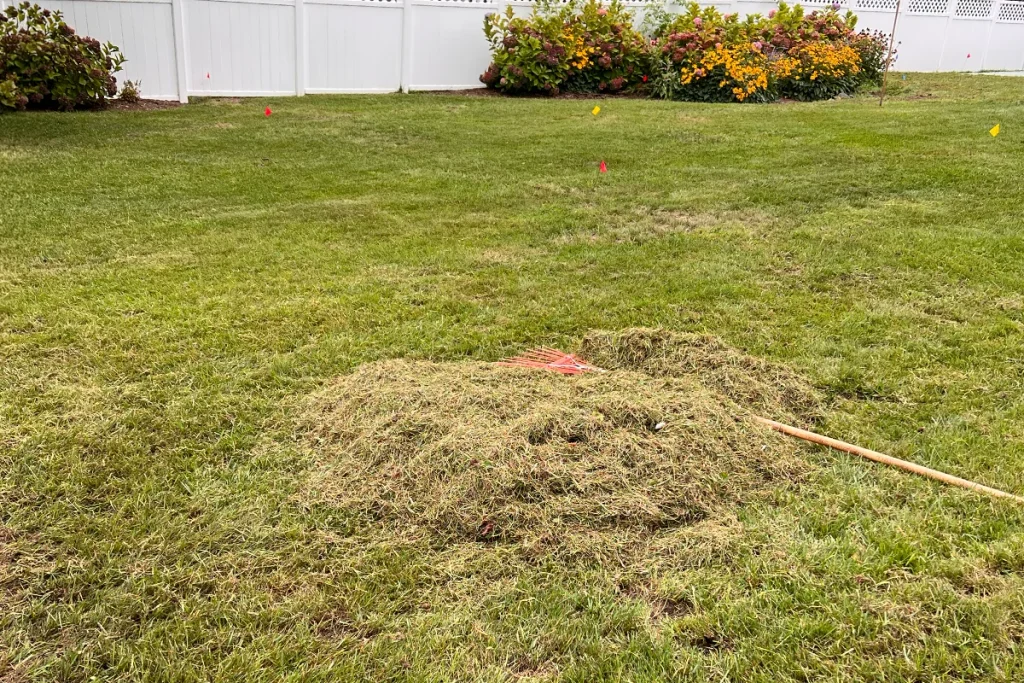
If a lawn has developed a substantial layer of accumulated organic material above the soil surface, professional dethatching may be appropriate before other renovation work.
A small amount of thatch is normal.
Excessive buildup can interfere with movement of water and air into the soil.
Poor Soil Conditions
Some Vineyard lawns drain extremely quickly.
Others, particularly in certain up-Island areas, may contain heavier soil.
Top dressing, organic matter and other amendments should therefore be selected according to the property rather than automatically applied as the same mix everywhere.
Infinity’s lawn top dressing service is designed to improve the existing root zone while coordinating with aeration and overseeding where appropriate.
Repair the Lawn — or Start Over?
Early fall is a good time for both repair and renovation, but those are not the same project.
Repair Makes Sense When:
- most of the existing turf is desirable
- summer damage is localized
- the lawn is thin rather than completely failed
- compaction can be corrected
- irrigation problems can be solved
- grading and drainage are fundamentally acceptable
In those cases, a combination of aeration, overseeding and targeted soil improvement may be enough.
Larger Renovation May Make Sense When:
- substantial areas are bare
- undesirable turf dominates the lawn
- severe grading problems exist
- drainage has failed
- construction destroyed the existing lawn
- weed pressure is extensive
- there is very little desirable grass worth preserving
When the decision is not obvious, our comparison guide explains the difference between preserving an existing lawn and establishing a new one:
Sod vs. Hydroseeding vs. Overseeding: Which Is Best for Your Martha’s Vineyard Lawn? →
For bare-soil projects, sod installation or hydroseeding may make more sense than simply adding seed to a failed lawn.
What Does a Typical Early-Fall Lawn Repair Include?
Not every property needs every service.
But when conditions call for a comprehensive repair, the sequence often involves several complementary steps.
Step 1: Evaluate the Lawn
Look at:
- existing grass density
- weeds
- soil compaction
- thatch
- irrigation
- drainage
- sun and shade
- summer traffic
- bare areas
The objective is to understand why the lawn declined before deciding how to repair it.
Step 2: Correct the Limiting Problem
That might mean:
- fixing irrigation coverage
- relieving compaction
- correcting drainage
- removing excessive thatch
- adjusting soil pH based on testing
- improving organic matter
- changing expectations in heavily shaded areas
There is little value in planting more grass into conditions that cannot support it.
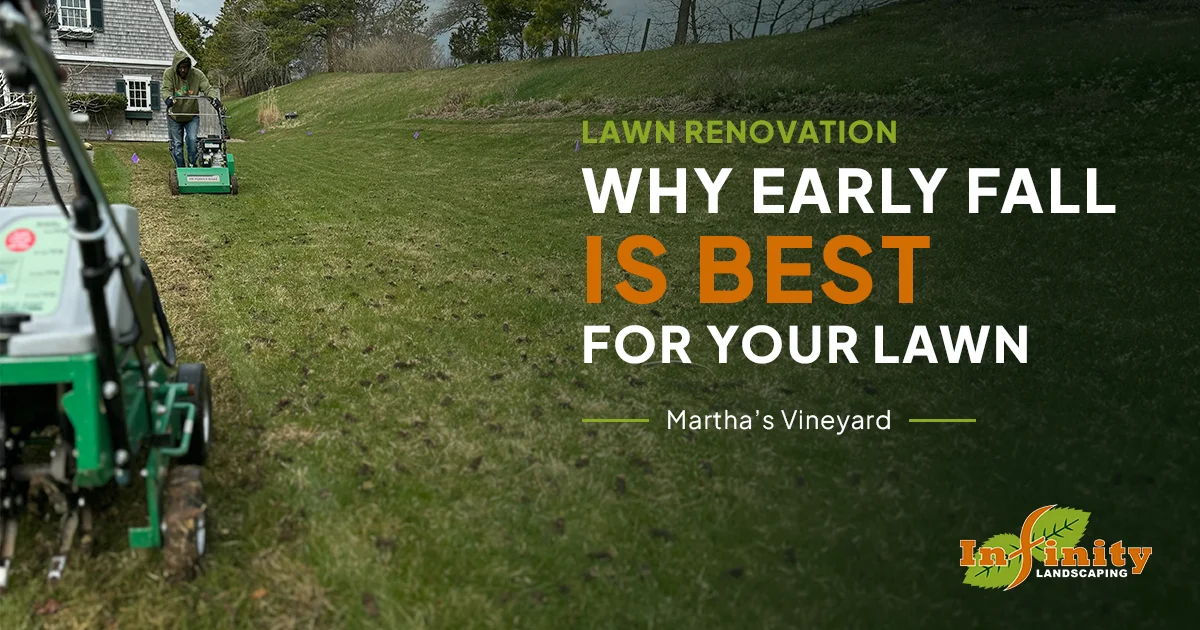
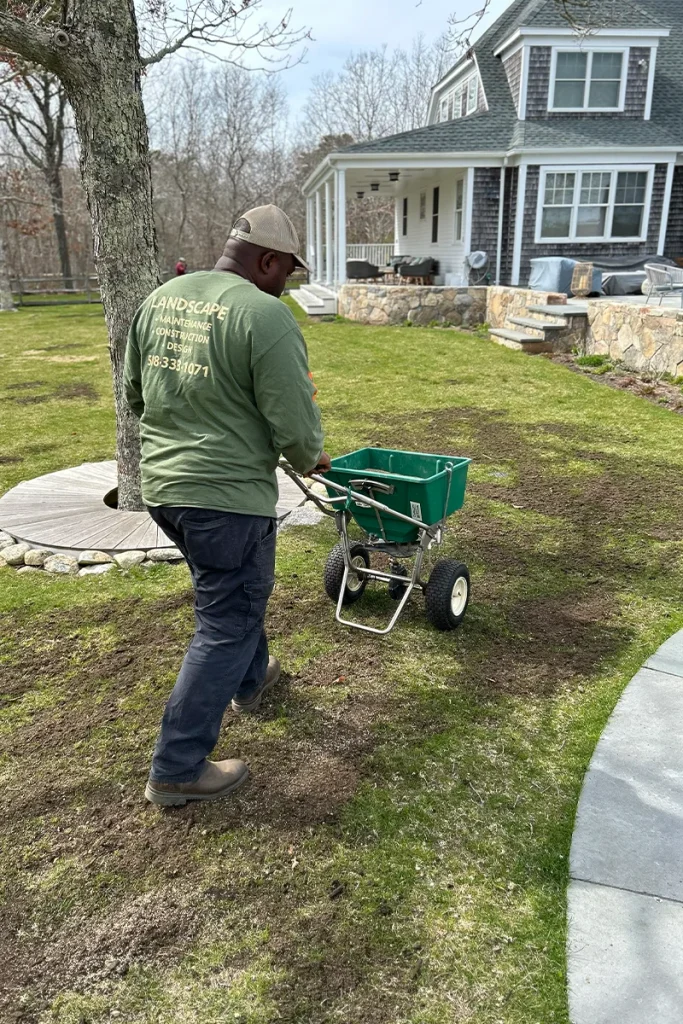
Step 3: Aerate Where Needed
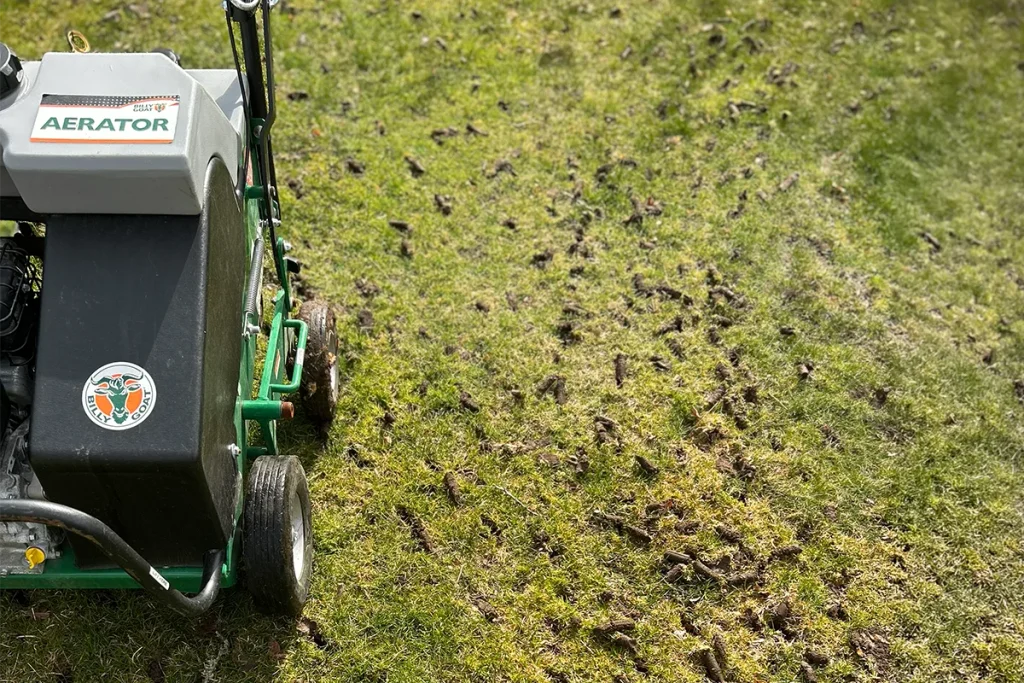
Core aeration and overseeding work particularly well together when compaction and declining density occur at the same time.
Aeration opens the root zone and improves opportunities for seed-to-soil contact.
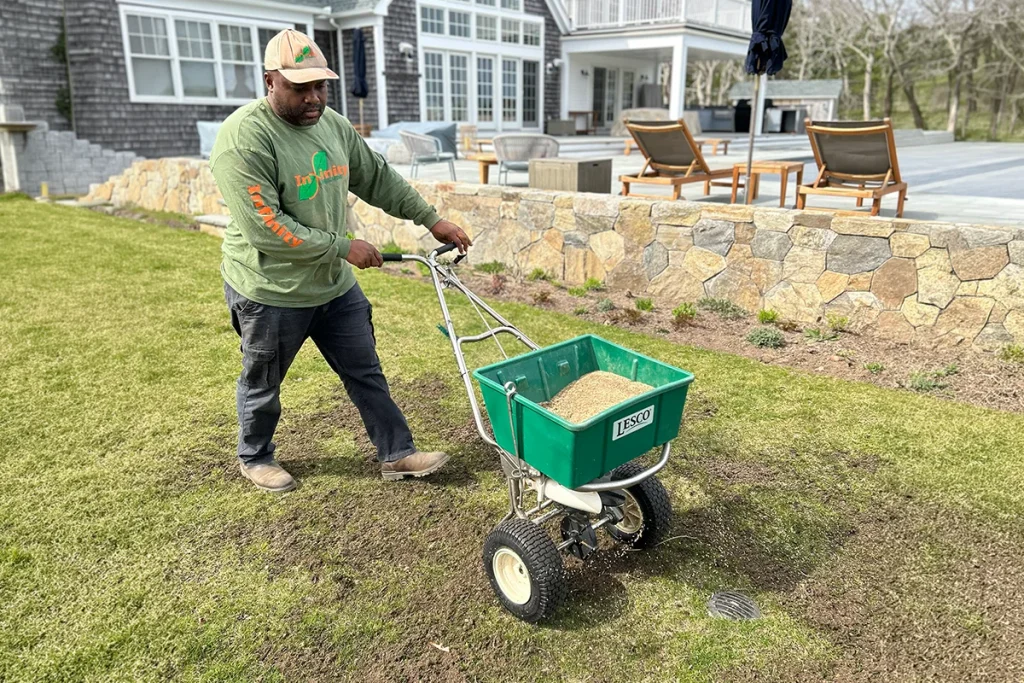
Step 4: Overseed Thin Areas
The grass blend should suit the property rather than being selected solely by price.
Consider:
- sunlight
- traffic
- drought exposure
- irrigation
- desired appearance
- existing turf
- coastal conditions
Step 5: Improve the Soil Where Necessary
A thin application of top dressing after aeration can introduce organic material into the root zone and improve certain soil conditions.
The material and application rate should be matched to the existing soil.
Step 6: Feed According to Need
Early fall is also an important fertilization period for many Massachusetts cool-season lawns.
Infinity’s lawn fertilization programs use soil information and turf condition to determine what should actually be applied.
Fertilization should support recovery and root development — not simply force excessive green top growth.
For a detailed explanation of the complete process, see:
Fall Lawn Care on Martha’s Vineyard: Aeration, Overseeding & Top Dressing →
Why Not Just Wait Until Spring?
Spring feels like the obvious season for lawn work.
And sometimes spring repairs are necessary.
But when a repair can be completed successfully in early fall, waiting until spring can introduce several additional challenges.
Weed Pressure Returns
Spring conditions favor germination of many unwanted plants as well as desirable turf.
Summer Arrives Next
Grass seeded in early spring has only a limited period to develop before it encounters summer heat.
By contrast, turf established in early fall has:
fall → winter dormancy → spring
before facing its first full Vineyard summer.
Pre-Emergent Weed Programs Can Complicate Seeding
Some lawn programs use spring pre-emergent products specifically to inhibit seed germination.
That can conflict with attempts to establish desirable grass at the same time.
You Lose Months of Root Development
A successful fall repair can enter the next spring as an established young lawn rather than a newly seeded one.
That is a significant advantage heading toward summer.
But Early Fall Is Not Always the Best Answer
Good lawn care requires exceptions.
There are situations where blindly following the “fall is best” rule would be poor advice.
Very Shaded Lawns
UMass notes an important exception for heavily shaded turf.
Where deciduous tree canopies create severe summer shade, early to mid-spring overseeding can sometimes perform better because more sunlight reaches the ground before trees fully leaf out.
In some locations, there may simply be too little sunlight to support a conventional lawn at all.
In those areas, changing the landscape may be more successful than repeatedly reseeding.
Dormant or Severely Drought-Stressed Turf
Do not aggressively renovate a lawn simply because the calendar says September if the existing turf is still severely stressed.
The property needs enough moisture and active growth to recover from cultivation.
Drainage or Grading Problems
If standing water, erosion or significant grade problems are responsible for lawn failure, solve those issues first.
Grass seed is not a drainage system.
Bare Soil Very Late in the Season
For a completely new lawn late in fall, sod installation may offer a more reliable option than attempting a major seed establishment after the optimal window has passed.
Martha’s Vineyard Makes Soil and Water Management Especially Important
A lawn-repair program developed for another part of Massachusetts cannot simply be copied onto every Vineyard property.
The Martha’s Vineyard Commission describes large portions of the Island as glacial outwash deposits dominated by sand and gravel.
Those soils can drain quickly.
That affects:
- irrigation frequency
- nutrient retention
- organic matter
- drought response
- establishment of new seedlings
At the same time, not every property is identical.
Certain western and hillier portions of the Island can have heavier soil conditions.
This is why Infinity does not treat “Martha’s Vineyard soil” as one universal soil type.
The property should be evaluated on site.
More Fertilizer Is Not the Solution to Sandy Soil
Fast-draining soil does not justify indiscriminate nutrient application.
Massachusetts and local organizations encourage careful fertilizer use because nutrients can move through soil and ultimately affect groundwater, ponds and coastal waters.
A better strategy is to build turf density, improve soil conditions where necessary and use targeted fertilization based on actual property needs.
What Happens After the Repair?
The work performed during one afternoon is only the beginning.
New turf has to establish.
First 1–2 Weeks
The priority is seed-zone moisture.
Recently seeded areas should not repeatedly dry out.
Heavy traffic should be minimized.
Weeks 2–4
Depending on turf species and conditions, germination becomes visible and new grass begins developing.
Irrigation gradually changes as seedlings mature.
Weeks 3–6
New turf begins tolerating careful mowing once it reaches appropriate height and establishment.
Existing grass continues recovering from summer stress.
Late Fall
Growth gradually slows.
Leaf accumulation should be managed so newly established turf is not buried under dense, wet layers.
Following Spring
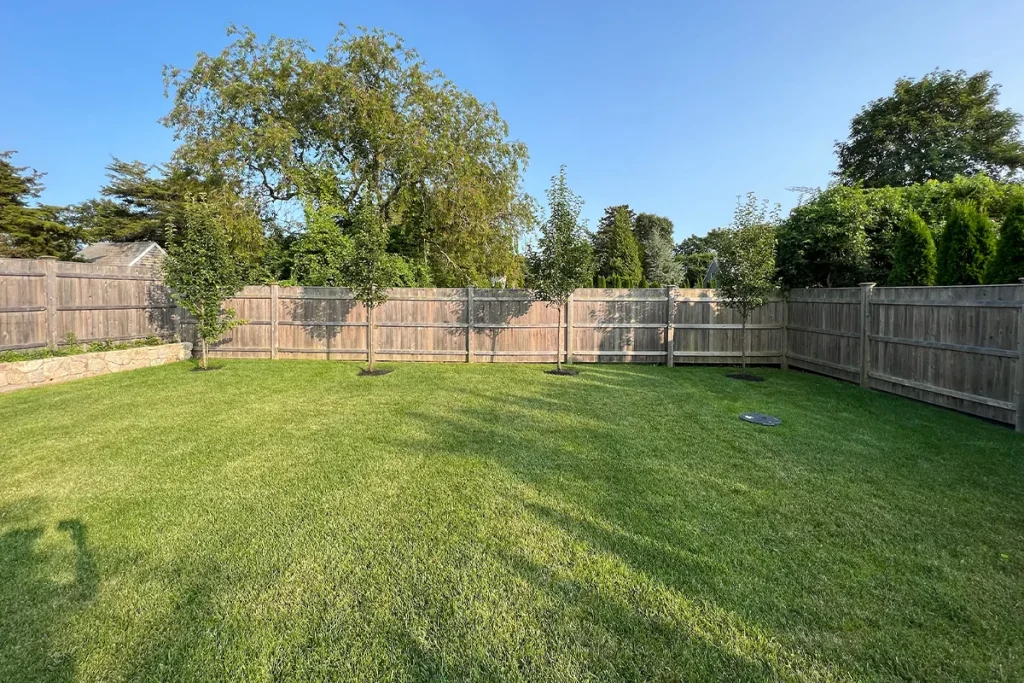
A successful early-fall repair should enter spring with an established root system and substantially better turf density than a lawn that was left thin all winter.
That is the real objective.
We are not simply making the lawn look better in September.
We are using September to improve how the lawn enters the following growing season.
Common Timing Mistakes We See With Fall Lawn Repair
Waiting Until the Leaves Are Already Falling Heavily
Homeowners often associate lawn repair with obvious fall weather.
By then, valuable establishment time may already have been lost.
The strongest planning period often begins while it still feels partly like summer.
Seeding During Peak Summer Heat
Seed can germinate in warm conditions, but keeping the shallow root zone consistently moist becomes significantly more difficult during hot summer weather.
Assuming October Is the Same as September
A few weeks can make a major difference in seed maturity.
Early October may still work.
Late October is a very different risk calculation.
Repairing Symptoms Instead of Causes
If the lawn repeatedly dies in exactly the same place, investigate:
- irrigation
- drainage
- shade
- compaction
- soil
- traffic
before applying more seed.
Performing Every Service Automatically
A healthy sandy lawn may not need the same cultivation frequency as heavily trafficked or clay-heavy turf.
Professional lawn care should be diagnostic.
Is Your Lawn a Good Candidate for Early Fall Repair?
Use this quick checklist.
Repair is probably worth considering if:
- the lawn became thinner over summer
- bare spots are relatively localized
- most existing turf is desirable
- high-traffic areas feel compacted
- irrigation issues can be corrected
- you want greater turf density next season
- the lawn has enough sunlight to support grass
- grading and drainage are basically functional
A larger renovation may be appropriate if:
- most of the lawn is undesirable
- extensive bare soil is present
- construction recently disturbed the property
- major grading is required
- serious drainage problems remain
- the lawn is being created from scratch
If you are deciding between preserving what is there and beginning again, start with:
Sod vs. Hydroseeding vs. Overseeding: Which Is Best for Your Martha’s Vineyard Lawn? →
The Best Lawn Repair Starts Before the Weather Feels Like Fall
The biggest takeaway is simple.
Do not wait for cold weather before thinking about fall lawn repair.
For Martha’s Vineyard cool-season lawns, late August and September create a valuable overlap:
summer damage is visible + soil is warm + air temperatures are moderating + weed pressure is lower + winter is still far enough away for establishment.
That combination does not last indefinitely.
The best result comes from assessing the lawn early, correcting whatever caused the summer decline, and using the strongest establishment window instead of waiting until the calendar is nearly out of time.
At Infinity Landscaping, we provide complete lawn care across Martha’s Vineyard, including core aeration and overseeding, top dressing, fertilization, dethatching, sod installation, hydroseeding and irrigation.
Does Your Lawn Need Repair Before Winter?
If your lawn looks thinner, worn or uneven after summer, now is the time to determine whether it needs simple overseeding or a more complete renovation.
Infinity Landscaping serves properties throughout Edgartown, Oak Bluffs, Vineyard Haven, West Tisbury, Chilmark and Aquinnah.
Request a free lawn evaluation and project estimate →
Call: (508) 333-1071
Frequently Asked Questions
What is the best month to repair a lawn on Martha’s Vineyard?
For many seed-based lawn repairs, September is the strongest overall month.
UMass Extension generally identifies late summer through early fall as the preferred establishment period, with the typical Massachusetts optimum running approximately from the third week of August through the third week of September.
Coastal areas and the Islands can sometimes maintain suitable conditions somewhat later.
Is late August too early for lawn repair?
No.
Late August can be an excellent time to begin lawn renovation once extreme summer heat begins moderating.
In fact, waiting until the weather feels distinctly autumnal can unnecessarily shorten the establishment period available before winter.
Can I overseed my lawn in October on Martha’s Vineyard?
Sometimes.
Early October can still provide usable conditions, particularly for overseeding into an existing lawn or smaller repairs.
However, establishment becomes progressively less reliable as fall advances.
If conditions are suitable in September, deliberately delaying into October generally offers little advantage.
Is spring or fall better for repairing a lawn?
For many cool-season lawns, early fall is preferred because soil remains warm, air temperatures are moderating, weed competition is reduced and new turf has time to establish before the following summer.
Spring repair can still be useful when fall work was missed or in certain site conditions.
Does every lawn need aeration in the fall?
No.
Aeration should address actual soil compaction or support a planned renovation.
Low-traffic lawns with healthy soil structure may not need the same cultivation frequency as heavily used turf.
Should I overseed after aerating?
When an existing lawn is thin and compaction is also present, combining aeration and overseeding can be very effective.
Aeration creates openings in the turf and can improve seed-to-soil contact while relieving compaction.
Should I fertilize when repairing a lawn in early fall?
Fall is an important fertility period for many cool-season lawns, but fertilizer should be selected according to the lawn and soil rather than applied automatically.
Infinity’s lawn fertilization programs are designed around property-specific soil and turf conditions.
Do newly overseeded lawns need irrigation?
Yes.
New seed must remain adequately moist during germination and early establishment.
Before beginning a large repair, check that the property’s irrigation system provides consistent coverage.
What if my lawn is too damaged for overseeding?
If very little desirable turf remains, simply adding more seed may not be enough.
Depending on the property, a more complete renovation using hydroseeding or sod installation may be more appropriate.
Compare all three approaches in our guide:
Sod vs. Hydroseeding vs. Overseeding: Which Is Best for Your Martha’s Vineyard Lawn? →
Are shaded lawns also best overseeded in fall?
Not always.
UMass Extension notes that heavily shaded lawns beneath deciduous trees can sometimes benefit more from early to mid-spring overseeding, when sunlight can reach the turf before tree canopies fully develop.
If the location remains too shaded for healthy grass throughout the season, changing the landscape or using a more shade-tolerant alternative may be more effective than repeated reseeding.
When should I contact a landscaping company about fall lawn repair?
Ideally, before September is already well underway.
Evaluating the lawn in late August gives time to diagnose summer damage, address irrigation or soil issues and schedule renovation during the stronger establishment window.