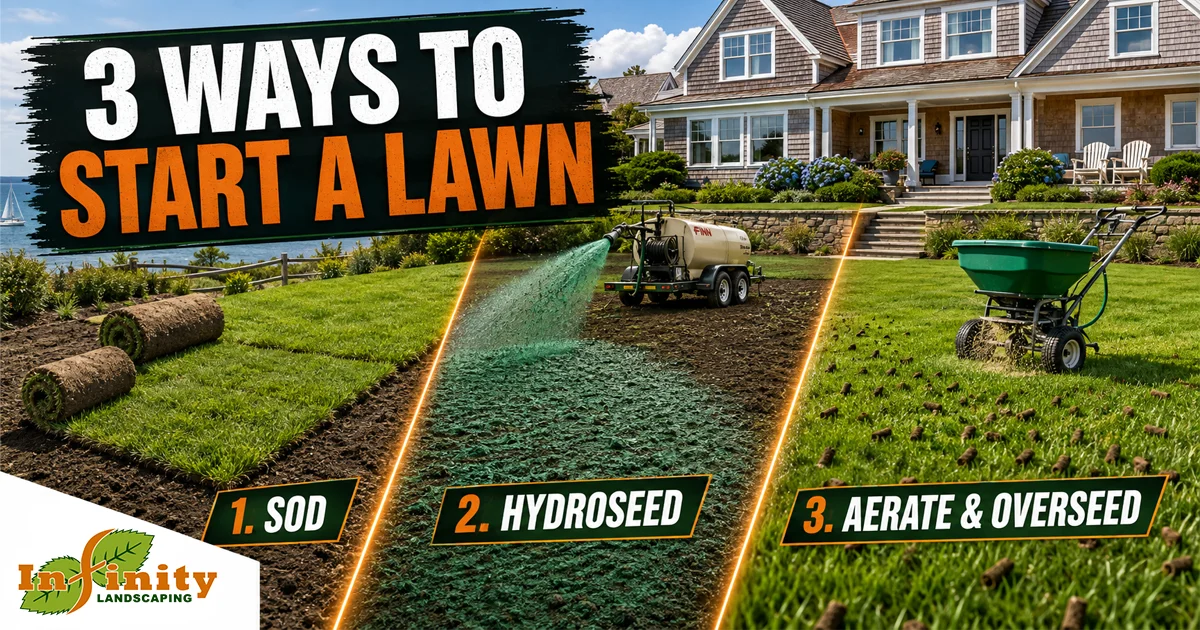
If you need to improve a lawn on Martha’s Vineyard, one of the first decisions is often:
Should we install sod, hydroseed the area, or overseed the lawn that is already there?
These three services are sometimes discussed as if they are interchangeable.
They are not.
The right choice depends first on what currently exists on the property.
- Sod is usually best when you need to establish a completely new lawn quickly.
- Hydroseeding is usually best when a large area of prepared bare soil needs to become lawn without the cost of covering the entire site with sod.
- Overseeding is usually best when a usable lawn already exists but has become thin, patchy or stressed.
All three can produce excellent turf.
The important question is not which method is universally “best.”
It is which method solves the problem your property actually has.
Infinity Landscaping provides all three options as part of our complete lawn care services on Martha’s Vineyard, which allows us to recommend the method based on the site instead of trying to make one solution fit every property.
The Quick Comparison
| Sod | Hydroseeding | Overseeding | |
|---|---|---|---|
| Best for | New lawns needing immediate coverage | New or renovated large lawn areas | Existing lawns that are thin or patchy |
| Existing grass required? | No | No | Yes |
| Appearance immediately after work | Finished green lawn | Mulched/seeded soil | Existing lawn remains visible |
| Establishment speed | Fastest | Gradual | Gradual |
| Upfront cost | Highest | Usually lower than sod on large areas | Usually lowest when existing turf can be preserved |
| Seed variety flexibility | Limited to available sod blends | High | High |
| Watering after installation | Essential | Essential | Essential |
| Good for large areas | Possible but expensive | Excellent | Excellent if existing turf is viable |
| Good for slopes | Very good immediate coverage | Very useful with mulch/tackifier | Only where existing turf remains |
| Best late-summer/fall use | New lawn | New lawn | Repairing existing lawn |
The rest of the decision comes down to timeline, site preparation, lawn condition, irrigation, erosion risk and budget.
First Question: Are You Creating a New Lawn or Repairing an Existing One?
This is the easiest way to eliminate the wrong option.
If the site is mostly bare soil
Your primary choices are:
sod installation or hydroseeding.
Examples include:
- a newly constructed home
- a major landscape renovation
- a lawn removed during construction
- severe grading or drainage work
- an area where undesirable turf has been completely removed
If a usable lawn still exists
The better starting point is often:
Overseeding is specifically intended to introduce new desirable grass into an existing turf stand.
UMass Extension describes overseeding as a renovation and repair strategy for lawns that still contain viable turf, rather than a replacement for complete new-lawn establishment.
If your lawn simply looks thinner after summer, ripping everything out and installing new sod may be unnecessary.
That is why diagnosis should come before the method.
Option 1: Sod — The Fastest Route to a Finished Lawn
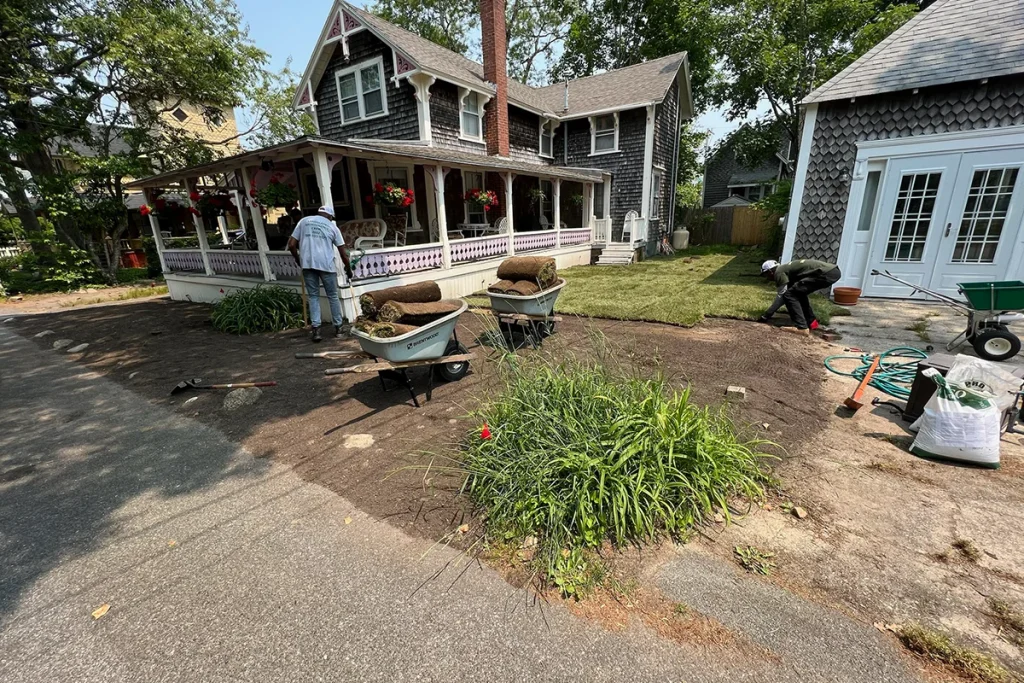
Sod installation uses mature turf that has already been grown at a turf farm.
The lawn arrives in rolls or sections with established grass and roots attached to a thin soil layer.
After proper site preparation, the sod is laid across the prepared soil, rolled for root-to-soil contact and watered immediately.
The biggest advantage is obvious:
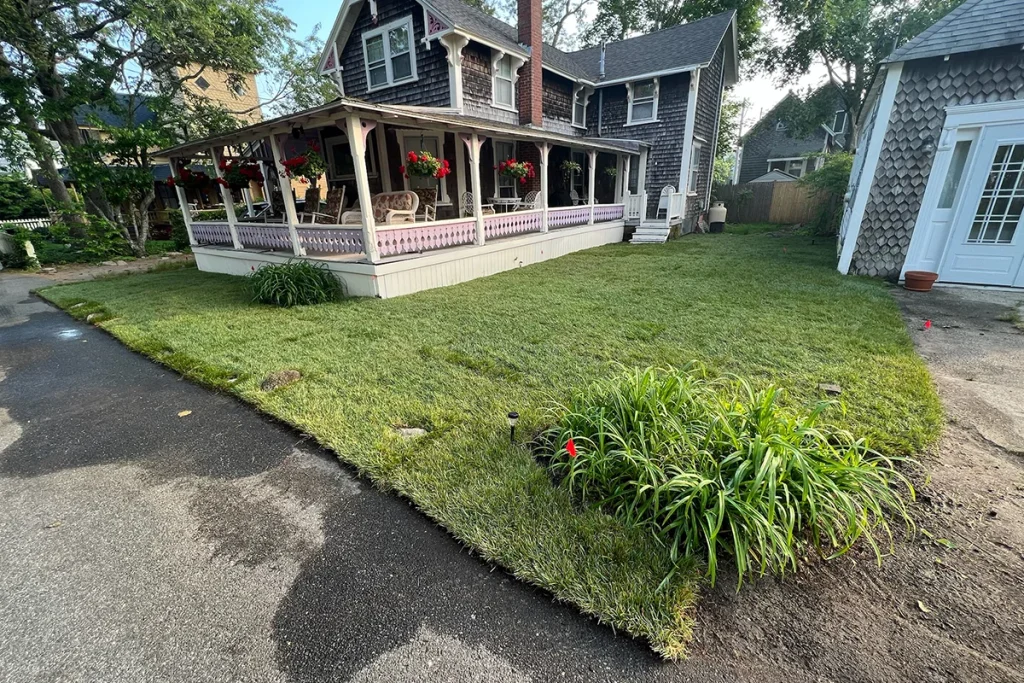
the property looks like it has a lawn as soon as installation is complete.
Sod Is Usually Best When:
- a homeowner wants immediate visual results
- a new-construction project needs to look finished quickly
- a property is being prepared for occupancy or rental
- bare soil cannot remain exposed for an extended period
- erosion control is important
- the lawn area is manageable within the available budget
- there is not enough time in the season for reliable seed establishment
UMass Extension notes that sod can often be installed later in the growing season than seed because it already consists of mature turf. As long as the soil is not frozen and soil temperatures support rooting, sod can remain a viable establishment option.
Advantages of Sod
Immediate Appearance
A properly installed sod lawn changes a property almost instantly.
There is no multi-week period of looking at bare soil while waiting for germination.
Rapid Surface Stabilization
Because sod immediately covers the soil, it provides excellent protection on areas where exposed ground could erode.
Lower Initial Weed Pressure
Quality sod arrives as established, dense turf, leaving significantly less open soil for weeds to colonize during the initial establishment period.
More Flexible Installation Timing
Seed establishment depends heavily on seasonal temperatures.
Sod still needs appropriate soil temperatures for rooting, but its installation window is generally broader.
Disadvantages of Sod
The primary tradeoff is cost.
You are paying for turf that has already been grown, harvested, transported and professionally installed.
On Martha’s Vineyard, logistics also matter because premium turf must be brought to the Island fresh and installed promptly.
Sod also offers less flexibility in choosing turf varieties than establishing a lawn from seed.
Sod Still Requires Proper Soil Preparation
An “instant lawn” does not mean instant roots.
The soil underneath still needs to be prepared correctly.
Infinity Landscaping’s sod installation process includes clearing, soil preparation, grading, installation, rolling and irrigation coordination.
If drainage, compaction or poor grading is ignored before sod goes down, those problems remain underneath the new lawn.
Option 2: Hydroseeding — Efficient New Lawn Establishment Over Larger Areas
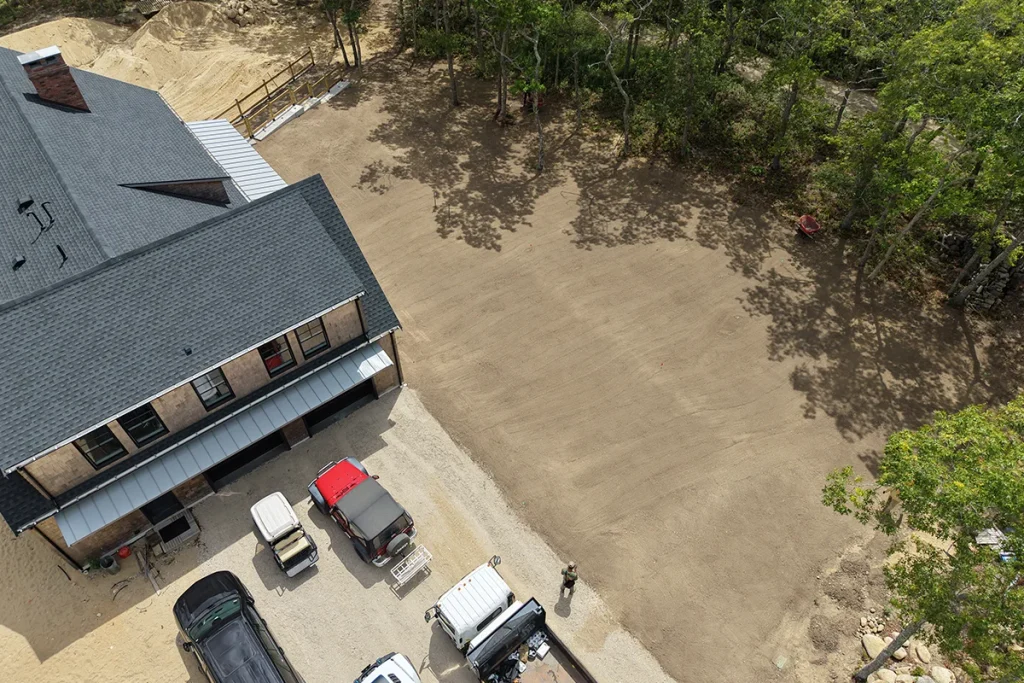
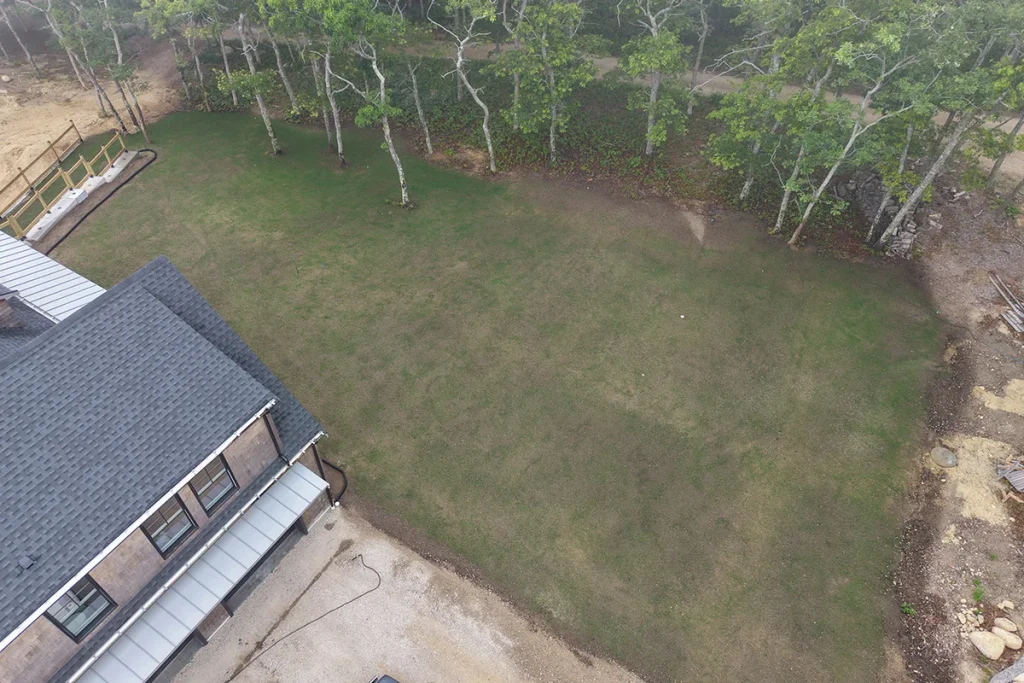
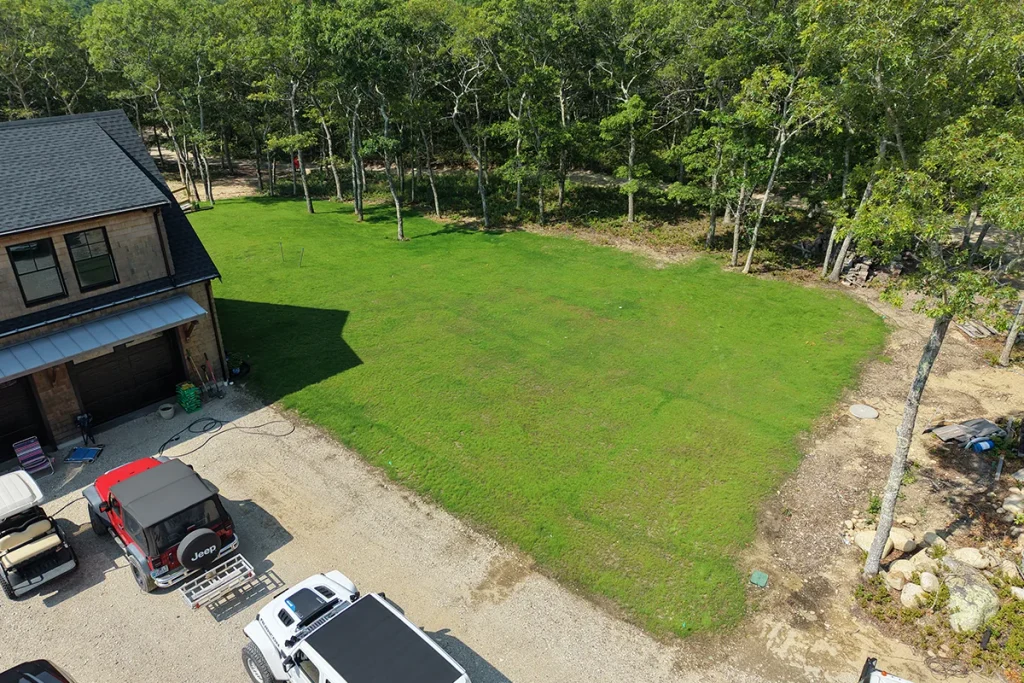
Hydroseeding is another method of establishing grass on prepared bare soil.
Instead of laying mature turf, a hydroseeding machine mixes grass seed with water, mulch and other appropriate materials into a slurry and sprays it evenly across the prepared area.
The result is not an immediate mature lawn.
It is a protected seedbed designed to grow into one.
Penn State Extension describes hydroseeding as particularly efficient for large sites and difficult areas such as slopes, while UMass recommends considering it on large or hard-to-access establishment sites.
Hydroseeding Is Usually Best When:
- a large lawn needs to be established
- the property has substantial prepared bare soil
- sod would make the project unnecessarily expensive
- flexible seed selection is important
- slopes or erosion-prone areas are involved
- the homeowner accepts a growing-in period
- irrigation is available for establishment
For larger Vineyard properties and new-construction projects, this combination often makes hydroseeding especially attractive.
Advantages of Hydroseeding
Efficient Coverage of Large Areas
A hydroseeding system can apply seed and mulch quickly over large prepared surfaces.
UMass lists rapid coverage of large sites as one of hydroseeding’s main benefits.
Useful on Slopes and Difficult Terrain
Hydroseeding mulch and tackifier can help hold material in place and reduce erosion while turf establishes.
That can be valuable on graded areas where conventional dry seeding would be difficult.
Greater Seed Selection Flexibility
Unlike sod, which is limited by what regional turf farms produce, hydroseeding allows the grass blend to be selected specifically for the site.
Factors may include:
- sun and shade
- irrigation availability
- expected summer traffic
- drought tolerance
- desired appearance
- coastal exposure
- disease resistance
Infinity Landscaping’s Martha’s Vineyard hydroseeding service uses seed blends matched to property conditions rather than one standard lawn mix.
Lower Upfront Cost Than Sod on Many Large Projects
For large new lawns, hydroseeding can often establish turf much more economically than covering the entire area with mature sod.
The tradeoff is time.
You are paying less for pre-grown turf because the lawn is being grown on the property.
Hydroseeding Is Not Maintenance-Free
One misconception is that hydroseeding eliminates the difficult part of establishing grass seed.
It does not.
UMass specifically notes that hydroseeding still requires careful irrigation during establishment.
The mulch helps protect seed and retain moisture, but it does not replace watering.
If the sprayed surface repeatedly dries during germination, establishment can become patchy.
That makes a functional irrigation system particularly important for larger hydroseeding projects.
Option 3: Overseeding — Repair the Lawn You Already Have
Overseeding is fundamentally different from the first two options.
You are not establishing a new lawn on bare soil.
You are introducing new grass seed into an existing lawn to increase turf density or repair thinning areas.
That makes overseeding extremely useful after:
- summer drought stress
- heavy seasonal foot traffic
- minor pest damage
- thinning caused by age
- isolated bare areas
- turf decline after difficult weather
UMass describes overseeding as a way to maintain density, repair damage and introduce desirable turf species into an existing living stand.
Overseeding Is Usually Best When:
- most of the lawn is worth preserving
- thin areas are distributed throughout the property
- the lawn has lost density after summer
- compaction is contributing to poor growth
- you want to improve turf without complete replacement
- the existing grading and soil structure are fundamentally usable
This is why overseeding is such an important part of fall lawn care on Martha’s Vineyard.
Our previous guide explains the seasonal process in more detail:
Fall Lawn Care on Martha’s Vineyard: Aeration, Overseeding & Top Dressing →
Why Overseeding Is Often Combined With Aeration
Seed cannot establish well if it never reaches the soil.
Broadcasting grass seed over a dense lawn canopy without preparation can leave much of the seed caught above the surface.
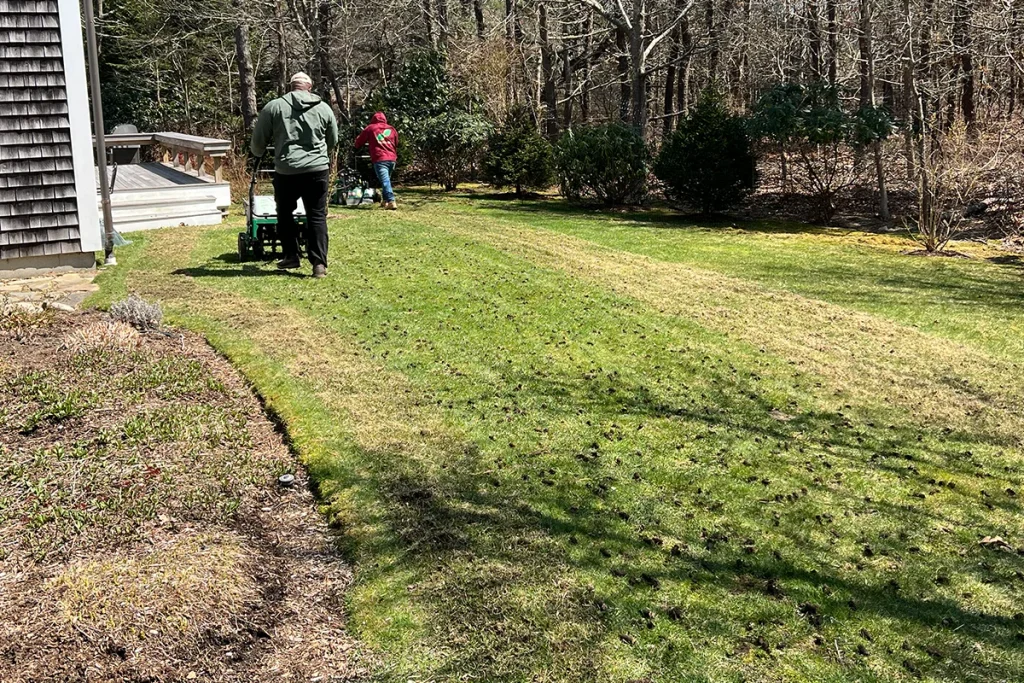
That is why Infinity typically combines overseeding with core aeration when compaction and turf density are both issues.
Aeration creates openings through the turf and improves opportunities for seed-to-soil contact.
UMass identifies proper seed-to-soil contact as a critical establishment factor and lists cultivation practices including aeration and slice seeding as useful renovation methods.
Overseeding Does Not Fix Every Lawn
A lawn that is 70–80% desirable turf may be an excellent candidate.
A lawn dominated by weeds, undesirable grasses, bare soil, drainage failure or severe grading problems may need a larger renovation.
Putting more seed onto a fundamentally failed lawn does not correct the reason it failed.
Which Option Costs Less?
There is no useful universal per-square-foot answer without seeing the property.
Site preparation can dramatically change the project cost.
But the general relationship is straightforward.
Overseeding
Usually represents the lowest investment when the existing lawn can be saved.
You are improving turf rather than removing and completely rebuilding it.
Hydroseeding
Usually provides a more economical method than sod for establishing large new lawn areas.
The homeowner trades immediate turf for a germination and establishment period.
Sod
Usually carries the highest upfront cost because the mature grass has already been produced elsewhere and must be harvested, transported and installed.
But cost alone should not determine the method.
If a high-value property needs an immediately finished landscape, sod may provide the best overall value even though the installation costs more.
Which Option Looks Good the Fastest?
There is no competition here.
Sod wins.
The lawn looks green immediately after installation.
Hydroseeding and overseeding both require germination and growth.
That distinction can matter significantly for:
- homes nearing completion
- properties being photographed or listed
- rental properties
- events
- high-visibility areas near entries and patios
- homeowners who simply do not want to look at a developing lawn
But even sod should not be treated as fully established on day one.
Roots still need time to connect with the underlying soil, which is why new sod requires careful irrigation and temporary traffic restrictions.
Infinity’s sod installation guidance recommends allowing approximately two to three weeks before normal heavier lawn use, depending on rooting and conditions.
Which Option Is Best for Large Martha’s Vineyard Properties?
This is where hydroseeding often becomes especially attractive.
Imagine a large new-construction property with tens of thousands of square feet of prepared soil.
Sod would provide instant results, but material, transportation and installation requirements increase with every square foot.
Hydroseeding can cover the same prepared area significantly more efficiently.
UMass specifically lists hydroseeding as useful for large or hard-to-access areas.
For estate-scale projects, that can make it the practical balance between:
cost + turf quality + installation efficiency.
However, irrigation capacity must be considered before choosing it.
A large hydroseeded lawn that cannot be watered consistently is not a well-planned project.
Which Is Best for Slopes?
Both sod and hydroseeding can work well.
Sod
provides immediate physical soil coverage.
Hydroseeding
allows mulch and tackifier to protect seed and help reduce movement on the slope during establishment.
UMass notes erosion-control benefits from hydroseeding mulch and tackifiers, while general turf-establishment guidance recognizes sod as an excellent option for immediate ground cover.
The correct choice depends on:
- slope severity
- drainage
- soil stability
- irrigation
- size
- timing
- budget
A steep slope with active erosion may require additional stabilization beyond simply choosing a lawn establishment method.
Which Method Needs the Most Water?
All three need dependable water during establishment.
The watering pattern is simply different.
Sod
needs the turf and underlying soil kept consistently moist while roots grow into the prepared base.
Hydroseeding
requires the seeded mulch layer to remain moist during germination.
Overseeding
requires moisture near the soil surface where the new seed is germinating between existing grass plants.
Seed-based establishment typically involves lighter, more frequent irrigation initially, followed by a gradual transition toward deeper watering as roots develop.
This is one reason Infinity can coordinate lawn establishment with irrigation installation, repair and system adjustments.
A new lawn method should never be selected without first asking:
How are we going to keep it alive during establishment?
The Most Important Factor Is Actually Soil Preparation
It is easy to focus on the final method because that is the part homeowners can see.
But the long-term lawn begins underneath it.
UMass Extension describes turf establishment as three basic phases:
- site preparation
- planting
- establishment care
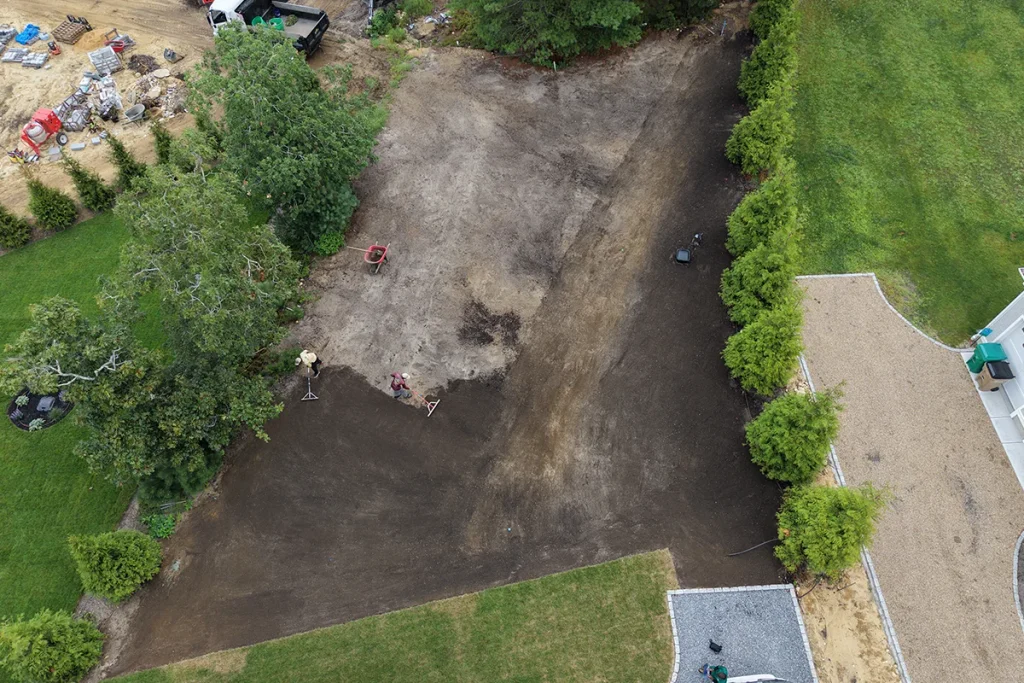
Site preparation can include:
- soil testing
- clearing
- cultivation
- drainage correction
- grading
- organic amendments
- seedbed preparation
That means excellent sod laid over poor soil can still struggle.
A premium hydroseed mixture sprayed onto compacted, badly graded ground can still struggle.
And premium grass seed broadcast into a lawn with unresolved drainage problems can still struggle.
When soil improvement is needed, services such as lawn top dressing and organic soil building may also become part of the solution.
A Simple Decision Guide
Choose Sod If:
- you are starting with bare soil
- immediate appearance is a priority
- the property needs fast surface stabilization
- the budget supports mature turf installation
- the project is happening later in the season
- you want the shortest visible establishment period
Learn more about sod installation on Martha’s Vineyard.
Choose Hydroseeding If:
- you are starting with bare prepared soil
- the lawn area is large
- budget efficiency matters
- you can support consistent irrigation
- you want flexibility in grass selection
- slopes or difficult areas need to be covered
Learn more about professional hydroseeding.
Choose Overseeding If:
- a usable lawn already exists
- turf has become thin or patchy
- you want to increase density
- summer stress damaged portions of the lawn
- soil compaction is contributing to decline
- a complete lawn replacement is unnecessary
Learn more about aeration and overseeding.
Sometimes the Best Property Uses More Than One Method
These methods do not have to be mutually exclusive across an entire property.
A landscape renovation might use:
- sod around the main patio and pool where immediate appearance matters
- hydroseeding across a large rear lawn
- overseeding in an existing front lawn that only needs renovation
This is especially relevant on larger Martha’s Vineyard properties where different zones have different priorities.
The goal should be to choose the right establishment method for each area, not force the same solution everywhere.
Because Infinity Landscaping handles complete lawn care, irrigation and broader landscape installation in-house, lawn establishment can also be coordinated with grading, planting, hardscape edges and irrigation rather than being treated as an isolated final step.
What About Timing on Martha’s Vineyard?
For seed-based establishment, late summer and early fall are particularly valuable.
UMass identifies approximately mid-August through mid-September as a highly favorable period for establishing cool-season turf from seed in Massachusetts.
That makes late August and September ideal times to evaluate:
- hydroseeding projects
- overseeding
- lawn renovation
- bare-area repairs
Sod offers a wider installation window because mature grass has already been established.
If you are trying to decide what your lawn needs right now, see our complete guide:
Fall Lawn Care on Martha’s Vineyard: Aeration, Overseeding & Top Dressing →
There Is No Universal “Best” Lawn Installation Method
The best method depends on what you are trying to accomplish.
If you need a finished lawn immediately:
Sod is difficult to beat.
If you need to establish a large new lawn efficiently:
Hydroseeding often provides the best balance.
If most of your existing lawn is still worth saving:
Overseeding is usually the more sensible approach.
What matters most is making that decision after evaluating the property.
At Infinity Landscaping, we assess the existing turf, soil, irrigation, grade, exposure, property use and desired timeline before recommending a lawn-establishment method.
That allows us to choose between sod, hydroseeding and overseeding based on the lawn you actually need — not simply the service we happen to be selling.
Need Help Choosing the Right Lawn Option?
Infinity Landscaping provides professional lawn care across Martha’s Vineyard, including new lawn installation, sod, hydroseeding, aeration, overseeding, top dressing and complete seasonal turf management.
We serve properties throughout Edgartown, Oak Bluffs, Vineyard Haven, West Tisbury, Chilmark and Aquinnah.
Request a free lawn evaluation and project estimate →
Call: (508) 333-1071
Frequently Asked Questions
Is sod better than hydroseeding?
Neither is universally better.
Sod is better when immediate appearance and rapid ground coverage are the highest priorities.
Hydroseeding is often better for large new lawn areas where cost efficiency and seed-selection flexibility matter more than immediate results.
Is hydroseeding cheaper than sod?
For many large lawn-establishment projects, hydroseeding generally requires a lower upfront investment than installing mature sod across the same area.
Actual pricing depends heavily on grading, soil preparation, accessibility, lawn size and Island logistics.
Is hydroseeding the same as overseeding?
No.
Hydroseeding generally establishes turf on prepared bare soil using a sprayed mixture of seed, water and mulch.
Overseeding introduces new seed into an existing lawn to repair thinning and improve density.
Should I overseed or replace my lawn?
If most of the existing lawn consists of desirable turf and the underlying problems can be corrected, overseeding may be sufficient.
If large areas are bare, dominated by weeds or undesirable grass, or affected by grading and drainage problems, more substantial renovation may be necessary.
How quickly does sod establish?
Sod creates immediate visual coverage, but the roots still need time to grow into the underlying soil.
Infinity Landscaping generally recommends minimizing heavy traffic for approximately two to three weeks while rooting develops, depending on site and weather conditions.
How long does hydroseeding take to grow?
Germination timing varies according to grass species, temperature, moisture and site conditions.
Some grasses can begin germinating within the first week, while full lawn density takes considerably longer.
Hydroseeding should be viewed as growing a new lawn, not installing an instant one.
What is the best time to hydroseed on Martha’s Vineyard?
Late summer into early fall is one of the strongest periods for cool-season turf establishment in Massachusetts.
Spring can also work well when irrigation is available to support the lawn through increasing summer temperatures.
What is the best time to overseed on Martha’s Vineyard?
Late summer and early fall are generally ideal.
UMass identifies approximately mid-August through mid-September as a particularly favorable establishment window in Massachusetts.
Read our complete Martha’s Vineyard fall lawn care guide for more detail.
Can sod be installed later in fall?
Often, yes.
UMass Extension notes that sod can remain a viable establishment option later in the season as long as the soil is not frozen and temperatures remain suitable for root development.
Do all three methods require irrigation?
Yes.
Sod, hydroseeding and overseeding all require careful moisture management during establishment.
If irrigation coverage is poor or unreliable, that issue should be corrected before investing in a major lawn project.
Learn more about Infinity Landscaping’s irrigation services.
How do I know which method my property needs?
Start by determining whether the property needs a new lawn or an existing lawn renovation.
Then evaluate:
- soil
- grading
- drainage
- irrigation
- existing turf condition
- size
- timing
- erosion risk
- budget
- desired completion speed
For a site-specific recommendation, request a free lawn evaluation from Infinity Landscaping.