
TL;DR: The best landscape lighting ideas for Martha’s Vineyard layer a few simple techniques. Uplight a shade tree, graze a stone wall, and keep paths softly lit. Warm 2700K light, shielded fixtures, and solid brass hold up to salt air and respect the Island’s dark skies. Most full systems run $2,000 to $6,000. Start with a plan, then see it lit after dark before any wire gets buried.
—
Good landscape lighting ideas for Martha’s Vineyard start with restraint, not wattage. A few well-aimed fixtures do more for a property than a yard full of bright lights. The goal is a warm, layered glow that shows off your stonework, gardens, and architecture while keeping the night soft.
The Island adds its own rules to the mix. Salt air corrodes cheap fixtures within a season or two. Up-Island towns protect their night skies with real bylaws. And the look most homeowners want here is understated, the kind that reads as elegant rather than staged. This guide walks through the techniques, fixtures, and choices that work on Vineyard properties, plus what a quality system actually costs.
Which landscape lighting techniques work best on the Vineyard?
Five core techniques cover almost every Vineyard property: uplighting, downlighting, moonlighting, path lighting, and silhouetting. The best systems layer all five at different heights and angles so the yard looks finished after dark instead of spotlit.
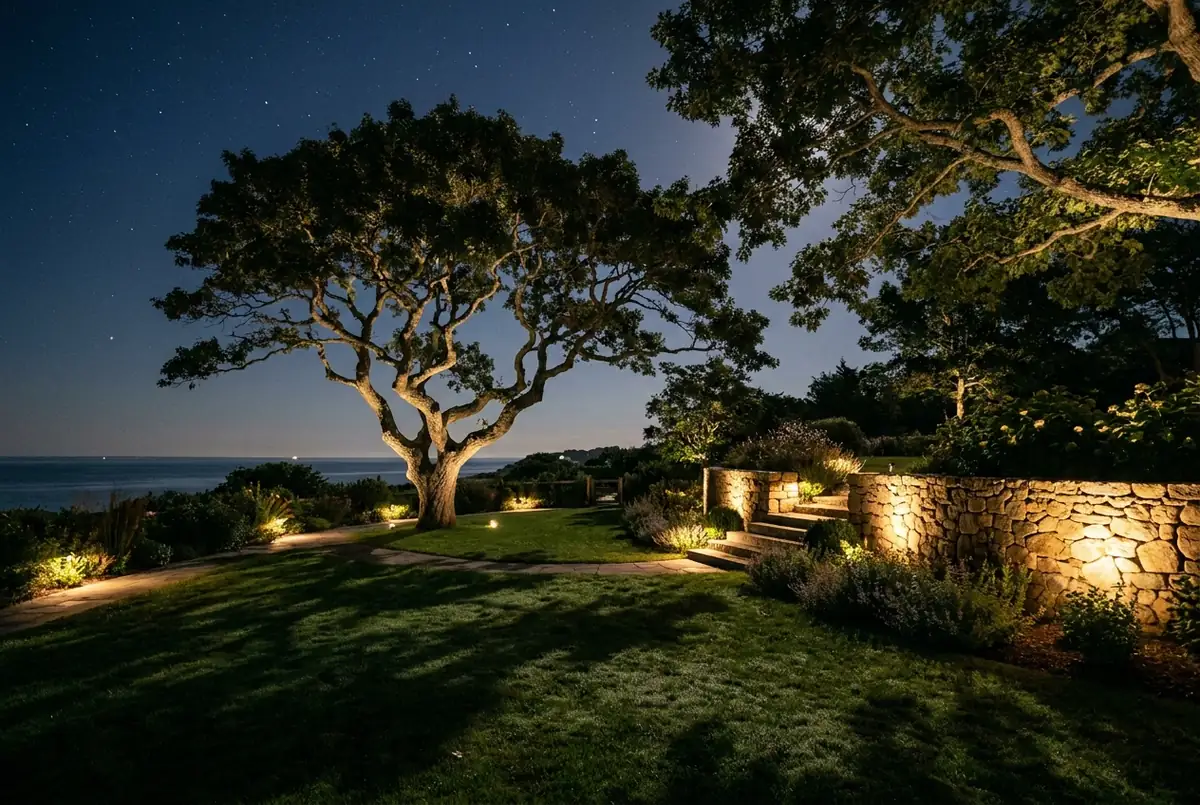
Each technique has a job. Uplighting places a fixture low and aims it up to dramatize a tree trunk, a shingled gable, or a specimen plant. Downlighting does the opposite, washing a soft pool of light onto a patio or walkway from above. Moonlighting is downlighting mounted high in a tree, so light filters through the branches and throws gentle shadows on the ground, much like a full moon. Path lighting keeps fixtures low and shielded to mark steps and walkways without glare. Silhouetting puts the light behind a shapely shrub or grass so its outline stands dark against a lit wall.
Here is a quick reference for matching technique to feature:
- Uplighting: A dramatic glow from below for trees, gables, chimneys, and specimen plants.
- Downlighting: A soft wash from above for patios, driveways, and seating areas.
- Moonlighting: Dappled light through branches for large oaks, dining terraces, and lawns.
- Path lighting: Low, shielded guidance for walkways, steps, and garden edges.
- Silhouetting: A dark shape against a lit backdrop for ornamental grasses and sculptural shrubs.
You do not need every technique on every property. Pick two or three that fit your home, then build from there.
Lighting ideas for paths, steps, and entries
Start where people walk. Path and step lighting is the most useful layer on any Vineyard property because it solves a real problem, which is moving safely between the driveway, the door, and the yard after dark.
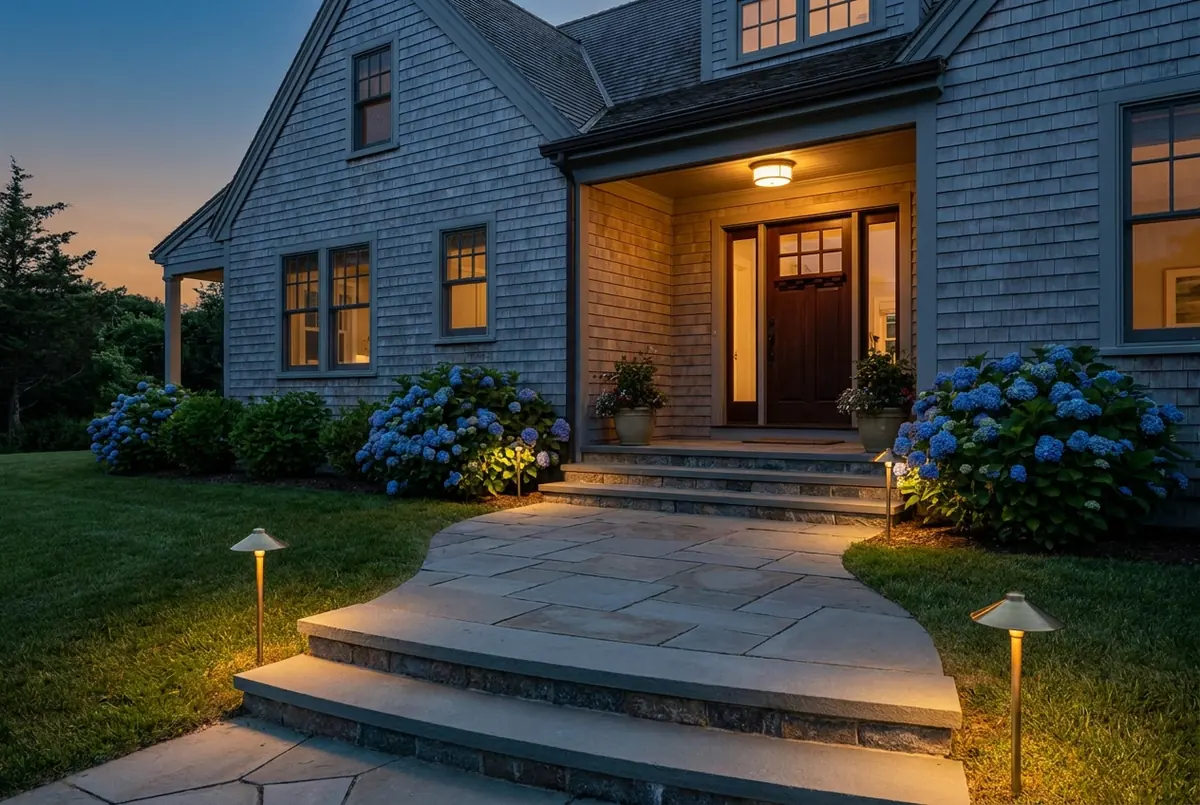
Keep path fixtures low and spaced out. A common mistake is lining a walkway with too many lights set too close, which produces a runway look instead of a guided path. Stagger fixtures every six to eight feet, and let pools of light overlap gently rather than blur into one bright strip. Shield each fixture so you see the light on the ground, not the bulb in your eyes.
Entries deserve a softer touch. A pair of downlights from a porch overhang, or a low wash across the front steps, makes a doorway welcoming without flooding it. For deck stairs and built-in seat walls, recessed hardscape lights tucked under a cap tread the line between safety and atmosphere. Our lighting design and installation work usually begins with these high-traffic zones before moving to accent features.
How do you light a coastal home without fighting salt air?
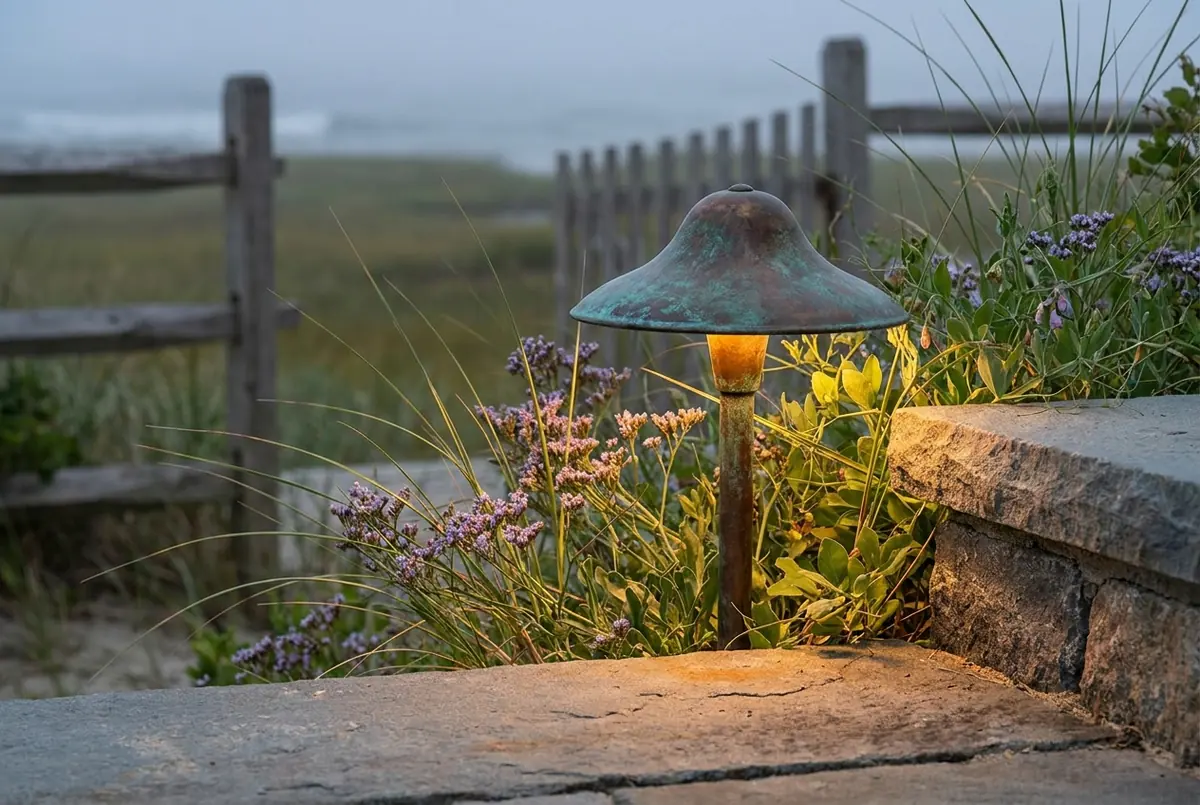
Use solid brass or copper fixtures, not aluminum or coated steel. Salt air and humidity corrode weaker metals within a season or two, while brass and copper form a protective patina that actually shields the metal underneath.
This matters more on the Vineyard than almost anywhere inland. The copper content in brass gives it natural resistance to saltwater corrosion, which is why marine hardware has used these metals for centuries. Aluminum fixtures depend on a surface coating, and once that coating chips near the coast, the metal pits and flakes fast.
Expect brass and copper to change color. Over a few years they darken to a brown or soft green patina. Most Vineyard homeowners come to like the aged look, since it suits the Island’s weathered shingle style. If you want a specific finish, tell your installer up front, because patina is hard to reverse once it sets. Pair coastal-grade metal with sealed, IP66-rated housings and good connections, and a system can run for years with only routine lighting maintenance and repair.
What color temperature is best for Vineyard landscapes?
Choose 2700K warm white for most residential landscapes. It reads as inviting and natural on shingled homes and gardens, and it is the most preferred color temperature for landscape lighting among designers.
Color temperature is measured in Kelvin. Lower numbers look warmer and more amber, higher numbers look cooler and bluer. At 2700K you get a candle-like warmth that flatters stone, wood, and foliage. By 4000K and up, light turns harsh and clinical, which suits a parking lot more than a Vineyard garden. Warmer light is also easier on the night sky, since DarkSky International recommends 2700K or lower to cut blue emission.
One practical tip: keep the whole system at a single color temperature. Mixing 2700K and 3000K fixtures across one yard creates an uneven, patchy look that the eye picks up immediately. Decide on one warm tone and hold to it.
Lighting ideas that respect the Vineyard’s dark skies
Dark-sky friendly design is not optional in some Vineyard towns. Chilmark adopted the Island’s first outdoor lighting bylaw in 1998, and it requires fixtures to be shielded, aimed downward, and mounted no higher than the eaves of a structure. West Tisbury and Aquinnah have similar protections, so up-Island plans need to account for them from the start.
The design principles are simple. Aim light only where it is needed, use no more brightness than the task requires, shield the source so it casts no light above the horizontal, and lean warm. These are the same responsible lighting principles DarkSky promotes everywhere, and they happen to produce a better-looking result too. Several Massachusetts towns now carry ordinances, and the trend is growing.
Even in Edgartown, Oak Bluffs, and Tisbury, where bylaws are looser, the dark-sky approach is the right one for neighbor comfort and for the Island’s character. For the full breakdown, see our guide to dark sky landscape lighting and our dark-sky compliant lighting service.
What does landscape lighting cost on Martha’s Vineyard?
Most professionally installed systems run $2,000 to $6,000, with the average homeowner spending around $4,000 for a system of about a dozen fixtures. Per fixture, expect roughly $100 to $300 installed, including materials and labor.
A few things move the number. Solid brass fixtures cost more than aluminum but last far longer near the coast, so they are the better value over time. A properly sized transformer adds $200 to $500, and longer cable runs or tricky access raise labor. Smart controls and extra zones add cost but give you app control and scheduling, which our smart lighting and control systems handle through professional-grade transformers.
Budget for upkeep as well. An annual tune-up that covers cleaning, re-aiming, and bulb checks typically runs $250 to $600 depending on system size. Quality landscape lighting also tends to add value, with industry estimates putting the lift at 15 to 20 percent of perceived home value when it is done well.
See it before you commit
The smartest landscape lighting idea is to see the plan lit before any wire is buried. A live after-dark demonstration with portable fixtures lets you judge brightness, aim, and which features deserve light, so you are not guessing from a drawing.
Layer a few techniques, choose warm 2700K brass fixtures built for salt air, and design with the night sky in mind. That combination gives a Vineyard property a warm, lasting glow that suits the Island. If you would like a plan for your home, our team can walk the property, design the system, and run an on-site lighting demonstration before you decide. Reach out for a free design consultation.